Tony: Glad you liked the prospectus, which by necessity needs to contain a lot of 'heavy' information. I think we managed to present it in a clear and concise way. Of course, it helps that the central theme is so
compelling.
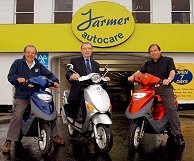
As for the website, I must take issue with your view that is 'jokey'. The inspiration was Honda's Power of Dreams campaign, taking big ideas and conveying them in a way that is informative, entertaining and easy to absorb. 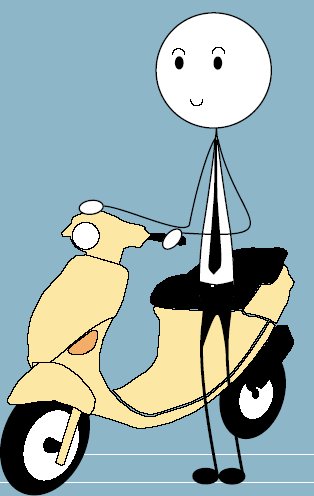 We receive a lot of positive comment about the animation at the start of our website, and Sam (left) the smart e-scooter rider will feature increasingly in our advertising. We never preach about the need to 'go green'. We merely present the practical and economic benefits of switching out of cars and into scooters and then highlight the quality of life advantages of 'e-riding': zero emissions, maximum fun.
EVUK: The company really does appear to be something of a clean, green EU-wide corporate heavyweight-in-the-making - in contrast to the many lean, cash-starved and largely idealism-powered one-man ebike/escooter bedroom start-ups out there.
- How many EV start-ups can boast a "Logistics Director", a "Marketing and Communications Director", a "Finance Director", an "Engineering Director" as well as a "Mobility Director"?
We are also very impressed by the company's clear commitment to next generation advanced batteries and and to other cutting-edge EV innovations such as high-efficiency, high-torque hub-motor technology.
Tony: Thanks. We strive to be professional in everything we do, and that's
one of the reasons Sir Tom Farmer came on board. We take a keen
interest in EV technology as we plan to be around for quite some time.
EVUK: When will the li-ion powered Raider 80 be available in the UK/Europe? And the Li-ion version of the Evader EV200?
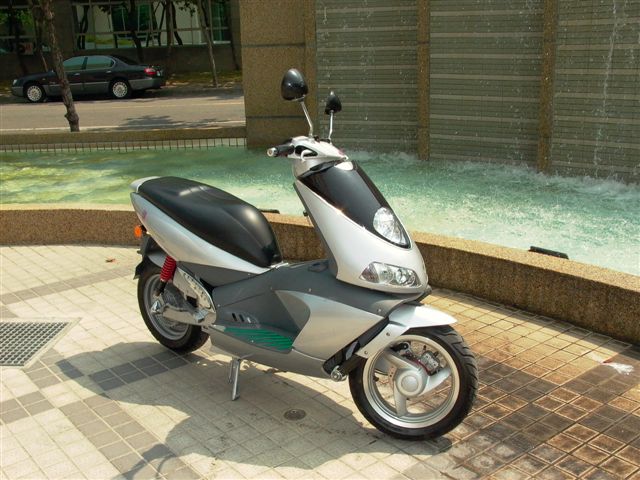
Lithium-powered Raider 80 - 50 miles/charge, 50 mph...due end '04. (Exclusive photo!)
Tony: We hope to receive our first lithium-ion Raider prototype before the
end of 2004. We're still talking to Evader about representation in the
UK, so I can't comment on the EV200 other than to say it looks a great
machine.
EVUK: We were also pleasantly surprised to see that ScootElectric has close links with the battery development team at Taiwan's Industrial Technology Research Institute(ITRI). As we reported last year ITRI are at the forefront of Li-ion nano-battery development - can you reveal anything to us on the that score - is the ITRI road-testing "nano-Li-ion" in electric bikes, scooters or EV's to your knowledge?
Tony: ITRI are currently testing five sample Li-ion e-scooters.
The tests began on September 1 and should be complete by the
end of November 30, by which time the scooters will have clocked up
12,500km of road testing between them. The samples have been submitted by one of our suppliers.
The test scooters are not equipped with nano-batteries but charge times should be significantly less than lead acid.
EVUK: When do you predict that the new improved hub motor from Raider mentioned in the prospectus (better acceleration and hill-climbing) will appear in that company's line of e-scooters?
Tony: Tests are going well but have uncovered 'spikes' in the torque curve. Although full torque is produced almost instantly, torque delivery is uneven which can result in jerky acceleration. However, this does not appear to be a major problem and the issue should be resolved by the end of 2004.
EVUK: On the question of pricing, you say, to quote the prospectus again:
"The Group's products currently compete in the 50cc class, where model prices start at £753 and rise to £2,199."
So given that Scootelectric's e-scooters range in price from £2,150 to £3,200 - in other words more or less double the cost of equivalent petrol scooters - the inevitable question arises(we're playing devil's advocate here of course - we're definitely on your side!) :
- Just how do you persuade prospective customers and shareholders to accept not only far higher retail prices but also to take on board the risk inherent in buying into an emerging technology developed and manufactured by relatively new, small fledgling companies?
To put it bluntly - just how do you persuade people not to say:
"Better the devil-you-know - ie. a low-cost 50cc fossil-fuelled scooter from an long-established, trusted company like, say, Peugeot - than a relatively high-priced, new-tech, green machine from a company with no real proven track-record that might possibly not be around in 3-4 years?"
Tony: Our full-size scooters are only twice the price of generally poorly
made Far Eastern imports. The premium over mainstream scooters is
actually not that great, and we can demonstrate lower whole-of-life costs: no petrol, no road tax and virtually no maintenance.
The Energy Saving Trust's £200 grant is also helpful, though we would like to see it at least doubled to really kick-start consumer interest.
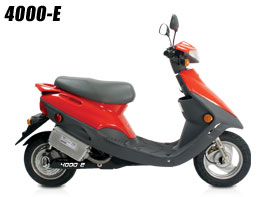
The award-winning direct drive EVT 4000e - up to 45 miles/charge
Since the prospectus was published, we have taken on the concession for the Powershift-approved eGO Helio, which costs £1100 after the grant, and we have gone live with the EVT 4000e(Electric Vehicle Technologies), which we sell for £1,950. We are in the process of putting all our models through Powershift testing.
Some of the companies behind this new technology are indeed "fledgling" - but there are also some very well established producers, the likes of JI-EE Industry (Magic) whose core market is OE automotive equipment. As you know, our Taiwanese partners also benefit from the colossal development work done at ITRI, putting them at the cutting edge of battery and electric motor development.
As for the marketing challenge, we do not set out to conquest die-hard petrol-scooter riders, rather suburban and city commuters who can appreciate the simple pleasure of getting from A to B without a great deal of cost or stress. Given the mandate for local authorities to source 'green' vehicles for their fleets, we feel there is tremendous potential in that area, and considering the high retail price and limited performance of four-wheel mobility vehicles, there is certainly also an opportunity for us to sell Trikes to people with a partial disability or poor sense of balance.
Time will tell if we're still around in 3-4 years but I can tell you our business is geared to an AIM flotation within the next 18 months and we envisage dominating a market that is certain to grow.
EVUK: Until a few weeks ago one of your suppliers, Evader USA, were
showing their EV100 and EV150 scooters priced at remarkably low prices - just $999 and $1199 respectively. (Rather worryingly all price
details appear now to have been removed from the company's website - see footnote below).
Did ScootElectric ever consider stocking these ultra-low-cost, budget Evader models. And if not, why not?
Tony: We haven't yet concluded our conversations with Evader about
representation, so I don't really want to comment on their product and pricing strategy. All I will say is that we expect any road-going electric
scooter to have good all-round performance - acceleration, top speed, hill-climbing ability and range - and it's encouraging to see the work Evader is putting in on motors and controllers. Consumers are prepared to pay the going rate for an electric scooter that does the job.
EVUK: Again, according to the company prospectus, public awareness of the ScootElectric brand "has been achieved through exposure of the Group's products on television and radio, in a variety of national newspapers, in more than 100 regional newspapers and in a range of magazines and media events."
You would not agree with us then that only a tiny percentage - in our view probably less than 2-3% - of the population are even aware of the existence or concept of battery-powered Vespa-style scoooters?
We have never for example in the countless TV & radio reports, discussions, phone-ins etc on the hot topic of congestion, pollution and global warming heard electric scooters/e-Vespas so much as mentioned - the public and journalists still seem to believe they are thinking imaginatively and right out of the box when suggesting people switch(..or should that be "Swap"..?) to petrol-powered scooters!
So do you not agree that there is still a vast void of e-scooter awareness out there?
Tony: Yes, I share your sense of frustration about media coverage - but I
believe ScootElectric has done a tremendous amount of high-quality work in this area, and the signs are that we are slowly getting through.
Of course, there is still much to do and we have set aside a significant budget to continue our awareness programme. What would really help is more commitment from central and local government.
For a start, I would like to see the Energy Saving Trust be more vocal about its mission and start promoting some of the technology featured on its Powershift Register.
On a local level, we would like to see recharging points and concessions for EV users. The recent "In Town Without My Car" Day presented an excellent opportunity to really get behind the notion of 'smart commuting' but it received little coverage.
But in our own home town of Colchester, which participated in the event for the first time this year, life - and traffic - carried on pretty much as usual (ie. gridlocked) while we shunted into an off-street to demonstrate our solution to the problem!
EVUK: Do you know of any instance where e-scooters have featured or
even been mentioned on national TV?
Tony:Yes. We showed one of our scooters on ITV's "This Morning"
programme a while back. We've also been on some satellite channels,
including BBC News 24.
Part of our media plan for 2005 will involve greater focus on national TV exposure.
EVUK: Celebrity endorsement:
- Would ScootElectric consider engaging an A- or B-list celebrity to endorse ScootElectric's e-scooters and/or electric e-Vespas in general?

For example: UK-residing Gwyneth Paltrow is now pretty famous for riding around London on a petrol-powered scooter - this may be pure fantasy on our part but could Sir Tom perhaps not have a gentle word in Ms. Paltrow's ear?(I think you might enjoy this Sky News report about Gwyneth and her scooter).
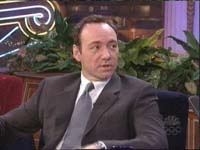
And another London-residing anglophile - Kevin Spacey - who's a fan of electric Zappy scooters(see EVUK's Spacey/Zappy report) - might be another willing candidate!
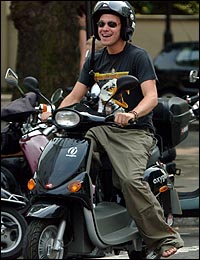 - Will Young breathes easy again on new Oxygen
Tony: Yes. Did you know Pop Idol Will Young rides an Oxygen, supplied by one of our London dealers? He was pictured in "Heat" magazine taking it for a spin. We'd like Will to be to us what Jamie Oliver is to petrol
scooters.
I'll also follow up your suggestion about Gwyneth Paltrow and Kevin Spacey - though the latter may want an American Beauty. I know Evader have their eyes on someone special because I've put them in touch with his agent. Watch this space.
EVUK: Looking to the longer term challenge - when - and what will it take - do you believe before e-scooters become a genuinely affordable and attractive option for all those teenagers that currently tear around so many European - especially Mediterranean - towns and cities on their noisy, smelly petrol scooters?
Tony: If it's a challenge to convert tearaway teenagers to electric
scooters, then it's a challenge we happily decline.
But to address the central point you make, about affordability and desire, then I believe we are already on the road to achieving those virtues. One of the quickest ways to get people talking about (and buying) electric scooters is to make them so cool that they're a must-have, and we're encouraging our manufacturers to focus much more on design and technology.
There's no reason for an electric scooter to be a Cinderella item, and advances in batteries, motors and controllers will give designers more scope to distinguish our models from their petrol rivals.
With increased demand, production and competition, ex-factory prices will fall.
EVUK: And finally...in the even longer term: would you rule out any possibility that ScootlElectric might one day consider expanding its product range from two wheels to four - form e-scooters to four-wheeled EV's - for example electric ATV's and eventually, as the technology matures, even electric cars?
Tony: We never rule out anything! If we can fulfil our ambition to build
ScootElectric into a respected and trusted brand - something that
cannot happen overnight - then I believe we will have permission to move into other areas of the zero-emission personal transport market.
Related links/Footnotes:
1) Will Young's original electric scooter - as reported by The Sun newspaper - was stolen in Aug 04, but as mis-reported by The Sun and others, it was not an "Eco 909" but a ScootElectric "Oxygen". Tony Cheverall explains:
"It was replaced by another Oxygen. In fact, before he bought the Oxygen, he tried a Magic and loved it. On the way over to see a mate, he was spotted by fans and chased down the street. He pulled up outside his friend's and ran in the house, leaving the keys in the 'ignition'. Of course, they were taken as a souvenir, which meant we had to replace the barrel!"
(You can just see the word "Oxygen" behind Will's knee!)
2) ScootElectric has also forged close ties with the world renowned Community Carbon Reduction Project (CRed) based at University of East Anglia - as well as with Good Energy - a leading provider of renewable energy. ScootElectric also has a servicing agreement with NSN (National Service Network) - a nationwide chain of over 500 standards-based independent garages.
3) Kwik-Fit founder Sir Tom Farmer backs ScootElectric - read the full story
4) Petrol-scooter fan Gwyneth Paltrow talks to The Independent about the state of her planet. But shouldn't she now copy Tom Hanks' fine example and go that extra "Green Mile" - go the whole hog - and make the switch to clean, efficient, whisper-quiet electric power?
EVUK has been reliably informed(again - see our Tom Hanks report...) by a very highly-placed Hollywood actor/environmentalist/EV-pioneer and Simpsons guest-star...that "Gwyneth Paltrow and her mother, Blythe Danner, already have an electric RAV-4". Oh - and he should know - he helped her get hold of them!(See Environmental Media Assoc. Press Release.)
5) Click here to see House of Lords-a-leaping..onto ScootElectric gear! Your Electric Representatives - several MP's and Peers, led by EV-trailblazing Lord Palmer, now zip around Westminster on e-scooters purchased from ScootElectric.
6) Evader USA (Prices: EV100 -$999 ?? EV150 -$1199 ??) tell us that the price guidelines have not changed and that they have decided to remove prices from their website following requests from distributors - especially in Europe - asking for greater pricing "flexibility". (So don't be surprised if $999 becomes Euros 1500..?)
7) Reminder: the range record-breaking French "Scooler" e-scooter(Belfort to Dijon - an official 102 miles/charge...see press reports) - is still looking for investors and development partners.
September, 2004
UK Li-ion Conference(Aug 28, 04) Update
To all those seeking more information on this year's event - we suggest the following three options:
- See Dennis Doerffel's REAPsystems Conference webpages.
- Join Thunder Sky/Li-ion Yahoo Discussion Group.
- Purchase copy of Conference CD!(See Conference webpage link above)
August, 2004
Solarvan's Thunder Sky upgrade - creator Peter Perkins updates us one year on...
- plus 'Rays of Hope' and 'Olympic EV Challenges'...
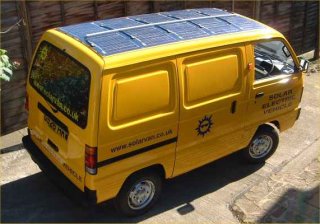
Solarvan - solar flair plus Thunder Sky range
We couldn't help but notice how little publicity the Solarvan's Sept '03 lithium ion upgrade had attracted so we decided to
ask the talented and tenacious Peter Perkins(webmaster@solarvan.co.uk) to fill us in and shed some more light on his ever-evolving
Bedford Rascal SEV.
We began by asking how the Thunder Sky("TS") batteries had been performing since they were fitted 11 months ago...
Peter Perkins: Pretty Well. I rarely go below 50% state-of-charge. I try hard not to abuse them.
EVUK: Are there any signs yet of any degradation in power and range from the TS cells - and how many miles have the TS cells
taken you to date - ie. since 30th September 2003 ?
Peter: No problems so far with power or balancing. I've only done about 1,500 miles with the li-ion cells so far though. I
would estimate range at about 100 miles max at 30mph - pretty good given that the Rascal has the drag curve of a brick .
Range at more normal speeds would be a lot less. I built my van for low speed cruising and range, I rarely go above 40mph. I
would use something much more aerodynamic if I was aiming for 50-60mph cruising speeds.
EVUK: The Yahoo Thunder Sky discussion group talk about certain
recharging problems with the TS cells - what's your experience, your solution?
Peter: I've not had any particular problems except building my own Battery Management System. I use a Zivan Ng3 20A
charger so I charge gently - less than the TS recommended 60A charge.
EVUK: Did you purchase the Thunder Sky batteries through Dennis Doerffel's (REAPsystems UK) TS bulk purchase scheme?
Peter: Yes - and I will be attending the Thunder Sky li-ion conference with the van at the end of August.
EVUK: Are you also of the opinion that the constant trickle charge from the solar cells will actually help keep the TS cells
in tip-top condition and boost their life expectancy? That is, do you believe the TS cells(or any batteries) in fact benefit
from this continuous(daylight) trickle charge?
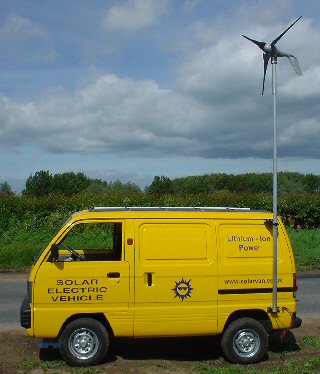
No - it's not a wind-up: the turbine is not attached when driving!
Peter: Well, I certainly hope so - but I have no real evidence to back this up at present. I implemented the
trickle-charging because I already had the cells on the vehicle. I needed to use the power or it would be wasted.
Trickle-charging is an issue though - Dennis (Doerffel) believes constant charging when cells are already full may be
harmful. In view of that I try to leave my van about 80% charged with some headroom to absorb the solar input without
overcharging them.
EVUK : Two questions on the Solara cells:
Firstly - is there any particular reason why you chose the Solara brand?
Peter: Not really. I chose them as they are thin(2mm), light and semi-flexible. They're bent to the slight curve of the
vehicle roof. Also the sizes available gave me most coverage of my vehicle roof.
EVUK: And secondly: you say that the 60 volt solar cells (quote) " would require only a small amount of work to upgrade to
120 volts". "Work" - yes - but what about cost?
Peter: The upgrade/work cost me nothing as I have 10x12volts panels. With lead-acid I used them in two parallel strings
of five cells giving 60V.
Now I use them all in series giving 120v. Just a small wiring change required. However, I only get half the current now of
course.
EVUK: Have you consulted closely with other UK lithium ion/Thunder Sky EV DIY'ers at all - such as Steve Green of Jester fame and the above-mentioned Dennis Doerffel? BTW: Steve Green recently returned from visiting Thunder Sky in China - see EVUK report). And are you signed up with the Yahoo Thunder Sky discussion group?
Peter: Yes - I am in frequent contact with Dennis and other Battery Vehicle Society members. I don't think I have spoken to Steve. Yes, I monitor many groups including the various Yahoo discussion groups.
EVUK : You say that the batteries could be hidden under the floor - if you were to do this AND keep another batch of
batteries above floor - do you think it would be relatively easy to get the range up to around 150 miles?
Peter: Yes. In fact with careful planning you could probably get enough batteries under the floor in my vehicle to give
150 mile range. 60x200ah cells would do that I'm sure.
EVUK: Regenerative braking - Steve Green has some kind of regen braking in his Thunder Sky li-ion Jester - so have you ever
considered tinkering with regen braking?
Peter: I have considered it, but I live in a very rural area I hardly ever use the brakes! It would be difficult to
implement with my series motor as well.
It's not worth my bothering. If I lived in the city/town then, yes, I would implement regen.
EVUK : Have you seen what the guys at FEVT (and others) have done by combining TS cells
with ultracapacitors(namely Maxwell Boostcap) ?
Peter: Yes, I exchange e-mails now and again with Viktor (Tikhonov) who has been installing some in his ACRX in US. It's very interesting - but I think if you get big enough cells then that might not be necessary! I recommend minimum 200ah cells for any EV system AC or DC. I am a bit worried about capacitors in an accident as well. Ultracaps might go off like a bomb if internally shorted. If li-ion fail, you might get a spectacular vehicle fire, but probably not instantly!
EVUK : Do you find yourself ever eyeing up other vehicles that have large roof areas and thinking what a great basis they too
would make for a solar electric conversion? Not just other commercial vans - how's about a solar-wind camper-van or a
solar-wind version of the famed Veggievan? Or a "Solar MPV" / People Carrier ?
Cars like the very popular Renault Espace, for example, would make great "Solar-MPV's", don't you think?
Peter: Possibly, but useful power from solar panels is low - especially here in the north of England. I might get a couple of miles a day from mine on a good day. They need to double in efficiency and half in price before that becomes a serious possibility.(We're not half as pessimistic - see "Rays of Hope" below.)
EVUK: What about the future? You say in the Sept 2002 Carkeys article(quote):
" I'm not interested in making cars for other people, unless someone comes along with a ludicrous amount of money,"
So have you had any interesting offers or imaginative suggestions at all recently that you might follow up?
Peter: I have had e-mails from people all over the world. Finland, India, South America offering to perhaps build my van.
I am not sure how serious these enquiries were. I am not in a position to exploit it yet. Technology needs more work.(Again - see "Rays of Hope" below.)
EVUK: Are you planning any more changes or upgrades at all for the Solarvan?
Peter: Yes - BMS version II ! More compact, completely solid state, able to be produced for others etc etc Improved
software.
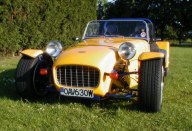
Peter Perkins' next project? A li-ion "locost" Lotus 7 ?
Over the winter I am thinking of building a "locost" Li-Ion electric kit-car similar to a Lotus 7 but much cheaper and
lighter!! That should give excellent performance and range - though possibly not comfort!
EVUK: In your Solarvan video(watch Windows or Real Player version) you say that some people may regard you as an eccentric - don't you agree then that they'd soon change their tune if you were to go that extra distance and join forces with others and turn a one-off wonder into a mass-produced, cheap-to-run, planet-friendly and congestion-charge-beating best-seller?
Peter: Of course and especially if the world's oil problems get any worse..
EVUK: A question about video and media interest in the Solarvan: the video's extemely professional - who made it? I guess
from the references in the video to the upcoming "new batteries" that it was shot just before the TS cells were installed in
Sept 03?
Peter: Correct. A German film crew came over after seeing the vehicle website, and shot it for an international satellite
TV motoring program called Lynx? It's been seen around the world a few times, and generated loads of hits on the web
site.
EVUK: Have national or local TV ever broadcast a report about it? The BBC for instance(feel the sarcasm!)?
And is the Carkeys piece the highest profile report so far on the Solarvan?
Peter: No, it's had no coverage on "normal" TV. I've been in a few local/regional papers with it. There was a little survey on the Top Gear site at one time asking for viewers' votes on my vehicle in their "Buff it or bin it poll"
EVUK: Thanks Peter - a lot of questions I know - but we're very curious people here at EVUK!
- Rays of hope and the Real-World Solar Challenge -
 Sunpower's low-cost, 21% efficient A-300 solar cells(available later this year) are already around a third more efficient than the Solarvan's Solara cells .
What's more the vehicle's PV
surface area could be further increased by adding a separate, perhaps folding and/or freestanding, PV array. A lightweight PV panel could easily double as a camper-van style sun canopy or awning whenever the vehicle is parked up in suitable locations. Let's also not forget that much of the developed and developing world is a whole lot sunnier and brighter than Peter Perkins' North Yorkshire!
And thinking beyond the Solarvan, the effectiveness - as opposed to the efficiency of the "EV-PV" cells - could be significantly enhanced by using a lightweight,
low-drag, aerodynamic base vehicle and by employing highly efficient dual hub motors. (Steve Green of Greener Energy tells us
he is now considering replacing the single Advanced DC motor in his 200 mile/charge, 71 mph Jester EV with the latest modular hub motors from UK/China-based company PML Flightlink: "An enormous improvement in overall drive efficiency" says Steve.)
A "Commuter Class" event is to be staged at next year's(2005) World Solar Challenge in Australia "to encourage practical cars that can be used for
commuting without polluting."
Not before time - for what ultimately is the point of years/decades of these
fun-in-the-sun wacky races they call "brain sport" if no real practical EV's - solar-assisted or not - ever appear in
car-showrooms? What a pity this real-world "commuting without polluting" event wasn't added to the Solar Challenge - and to
similar events - from the very beginning.
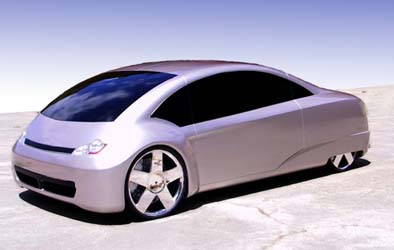
UNSA's Kestrel - more solar flair extraordinaire..
One very promising contender - one shining light - is the University of South Australia's Kestrel which is designed - and we hope destined - to bring solar race technology into the real world at last. Here's an extract from the Kestrel team's inspiring mission statement:
"While solar racing cars can travel 750km in a day at more than 90km/h, powered only by sunlight, most of us still drive
around town in cars that are big, heavy, noisy, and polluting.
The aim of this project is to design, develop, build and demonstrate a practical low-mass commuter vehicle powered entirely
by non-polluting renewable energy.
The most prominent feature of the Kestrel is the electric drive, and photovoltaic panels. This means that energy is taken
from a natural source, the sun, and converted to clean power. Although the car can fully charge in only a couple of hours on
mains power, solar panels on the roof ensure a steady power supply.
Construction materials are a lightweight honeycomb with carbon fibre panels. It has a range of 150 km(Reasonable range - we'd call that "Commuter Plus Class" - putting a little "fun" in "functional". EVUK Ed.). It uses lithium ion batteries and drives two motors of about 20kw each.
Gull-wing(Kestrel? Ed.) doors hinged at the centre spine allow easy and wide access - also reducing door weight.
Immense research has gone into aerodynamic development and as such, the Kestrel has a drag coefficient far better than any
other road car. A major feature of this is the smooth under-tray, mathematically calculated to maintain neutral lift and
minimal drag. This is possible because of its electric drive and as such eliminates the need for the usual mechanics that
clutter the underside of a normal car, such as gearbox, driveline, differential, etc. "
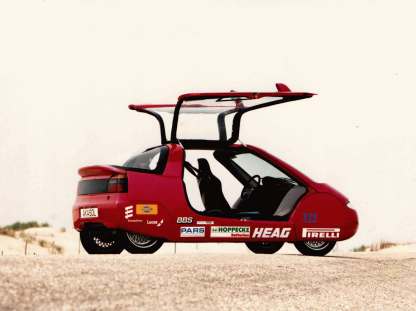
Akasol 'Chili' - red hot solar power!
Akasol(Germany) - the lightweight, low-drag, monocoque "Chili" EV embodies an almost identical
engineering and environmental design philosophy to UNSA's Kestrel - and gull-winged doors to boot!
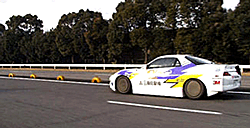
Ashiya University's 'Sky Ace Tiga' - Phaethon 2004 victor
Phaethon 2004 Solar Vehicle Race & Rally - part of the Greek Cultural Olympiad 2004. Won by Ashiya University's(Japan) Sky Ace Tiga. Ignored by Britain's (..and most of the world's) mainstream media. So see Phaethon 2004's own Press Releases.
According to the Phaethon race & rally organisers:
"The event sends a strong and clear message to the world for the necessity of protecting the environment from destructive
human activities. The Olympic Ideal calls for the respect of man as he functions within his natural environment.
Phaethon 2004 expresses precisely the Olympic Ideal and points out that, the same Sun, that ignites the Olympic Flame, can
also be a source of inexhaustible energy for humanity."
Sadly, and all-too predictably however, this high-minded Clean Vehicle message has not been translated to the Olympic Games
themselves as we once again see petrol-powered, exhaust-drizzling, camera-bikes, support vehicles, media "cattle-trucks" and even 4x4's weaving their way between finely-tuned, aerobically-hypersensitive road-race runners, walkers and cyclists.
No, not a ZEV - or even a hybrid - in sight...starved, as ever, of the oxygen of publicity. The same was true in Sydney - so will the 2008 Beijing Games be any different?? (Come on Oxygen SpA, Vectrix USA, Evader et al - isn't it time to take on an Olympic EV Challenge?)
Adiante 2004 - following the Phaethon 2004 rally, the world-beating Solar Race vehicle Nuna II travelled 6500 km through 15 European countries to promote zero-emission vehicle technologies and renewable energy. Again - an event ignored by Britain's (..and the world's) mainstream media.
Solarmobil - leading German EV/Solar EV sites and one of our firm favourites. "Solar EV" is
more loosely defined in Germany to encompass any low-mass, aerodynamic electric vehicles powered by solar or any other 100%
renewable energy source - whether on-board or not. And why not?! Hurdle the language barrier with Roland Reichel's superbly illustrated "EV Essentials and History".
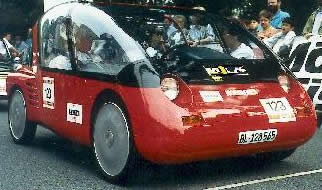
Horlacher Sport - 541 km range record in 1992
Horlacher Sport - a lightweight, aerodynamic, visually stunning EV - way ahead of its time. Set a world EV single-charge distance record of 541 km in 1992(the same year as the Kyoto Protocol was born - maybe it should have been renamed the Horlacher "Kyoto"?).
Solectria Sunrise - a very sunny name and - after achieving
a record-breaking 373 miles/charge in 1996 - theoretically a very bright and sunny prospect.  But since 1996 it's been more a case of Solectria Sunset or Solar Eclipsed - than Solectria Sunrise.
Dr Derck Schlettwein and his team of
nanotechnology specialists at Oldenburg University have developed micro-thin, low-cost PV materials(light-absorbing dyes, semiconducting) which they say can be
invisibly laminated onto a vehicle's bodywork and windows generating enough electricity to reduce overall energy consumption
by up to a third.(See German "Nano" TV report).
The road to "Light EV" enlightenment - from dinosaur-tech depths to Olympian heights demands the stamina of an endurance athlete. The challenge is Herculean and the opposition immense. Governments and the media spend billions promoting the Olympic Ideal and chasing the Olympic Dream in sport - but not in the cars we drive or the buildings we inhabit.
The truth is that the real-world solar challenge is not so much technological as it is political, commercial and financial - and will remain so as long as carmakers and their government and media servants - not to mention motorists themselves - so steadfastly refuse to see the light.
For some light but relevant relief:
Naked Gun 2 1/2, The Smell of Fear(1991) - solar energy, solar electric cars and a far-from far-fetched plot to sabotage them feature in this comedy classic starring ZAPWORLD patron Leslie Nielsen. Lieutenant Drebin (Nielsen) is out to foil a conspiracy to prevent a solar energy advocate from influencing George Bush Sr.'s Energy Policy. So why not rent the video/DVD and then ask yourselves(and your politicians/media) why little or nothing has changed since 1991...
 .
.
August, 2004
Steve Green's 'state visit' to Thunder Sky, China - full story/travelogue
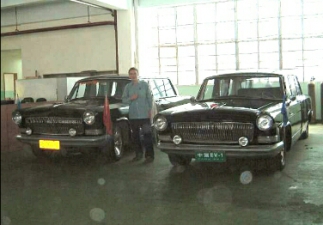
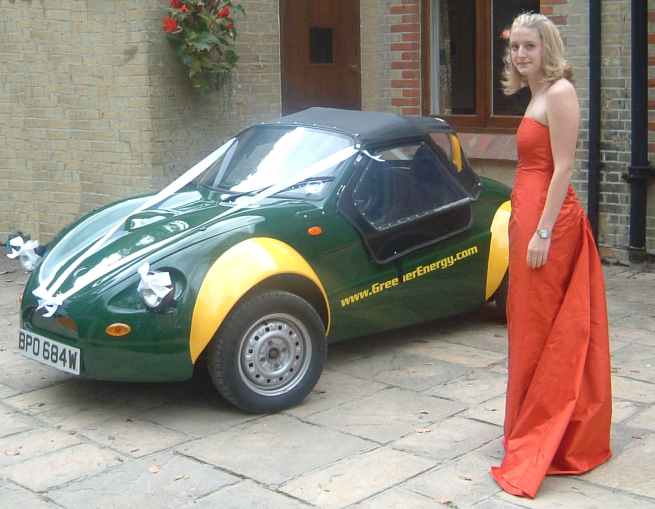
Steve Green with Chairman Mao's electrified limos
- including an all-electric, back-to-the-future Chairman Mao limo-ride...
 Steve Green, creator of the 200 mile/charge, Thunder Sky-powered Jester EV and founder of Greener Energy, has just filed this exclusive report following his recent return from a backpacking holiday-of-a-lifetime:
- Our visit to China was not a business trip: my wife and I had been wanting to go for some time and the opportunity arose to spend a few months backpacking round China and returning home on the Trans-Siberian railway.
We'd both decided to give up work but I still have a strong interest in electric vehicles as well as in certain specialist measurement techniques that my company had developed for the electric power generating industry. It also just so happens that the large company that my small company was subcontracted to on the measurement techniques have considerable interest in China and want these techniques to be used on power stations in China. Thus we thought that we could enhance our view of China if we could arrange to meet some real Chinese during our trip.
So we planned to fly into Hong Kong and work our way roughly up the middle of
China leaving on the Trans-Siberian from Beijing. Shenzhen was
more or less on our route and I was keen to see the Thunder Sky(TS) operation. I had emailed them before we set off from the UK emphasizing I was on holiday, not business, and with my wife - and they gave me a phone number to call to arrange the visit.
So you can imagine our surprise when my wife and I turned up hot and sweaty with our dusty backpacks at Shenzhen station and were shown to an enormous black car equipped with flags on the front bumpers. Although we were not a visiting president's entourage there was plenty of room in the back for a large gathering.
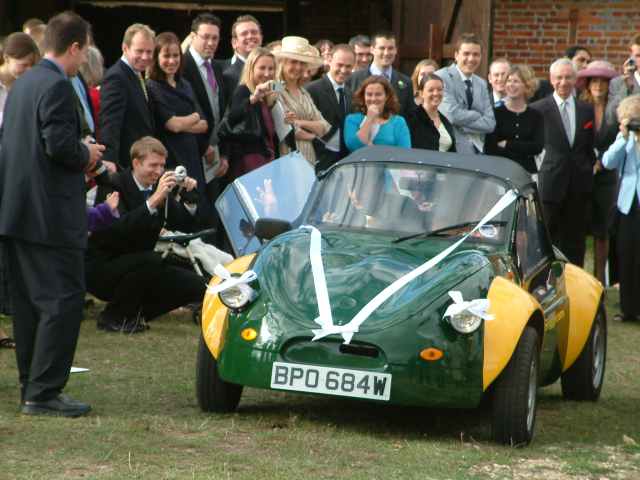
Anyway, we set off across town at a very brisk pace (in China that is very fast..) weaving in and out of the dense traffic. Our driver did not speak a great deal of English but we learnt on arrival at the TS offices that the car was powered by TS batteries. In fact it was one of two cars that had been hand-built for Chairman Mao and had been bought by the company as demonstrators.(VIP treatment for backpackers in a futuristic ex-Chairman Mao limo - how surreal is that?! EVUK Ed.).
We were shown to the conference room where we were introduced to Linda Ho, the elegant Chief Executive Officer of TS, who soon took pity on us not being used to the temperature and humidity in Shenzhen and rearranged the meeting in her very large and modern office. In this office the air-conditioning kept the atmosphere delightfully cool making it much easier to concentrate on technicalities. Fortunately Ms Ho has excellent English, although Chung Hing Ka, the inventor of the TS patented battery, does not - in fact his English was about the same level as my Chinese.
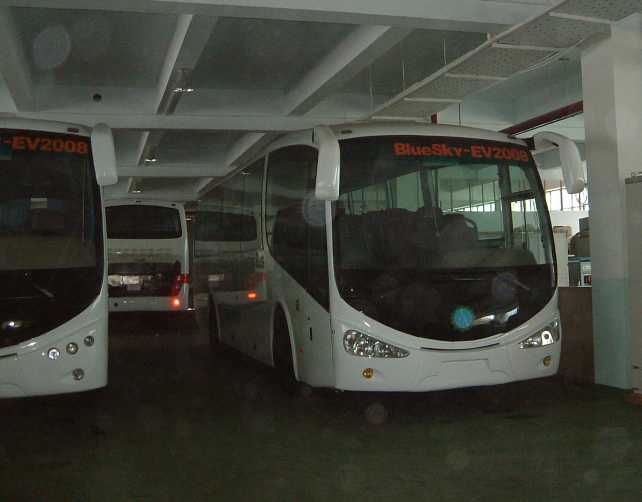
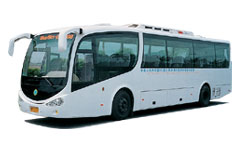
Yes - they're electric! Thunder Sky's 43-seater coaches
But with Linda Ho acting as interpreter we managed to discuss our application of their batteries, some battery characteristics and some of the charging and discharging problems that some(but by no means all..) early adopters have experienced. From the discussion it was apparent that TS have not yet solved all the problems associated with automated charging of multi-cell battery packs and the charging stations illustrated in the TS brochures and website are not yet available.
However, the vehicles they use to illustrate their batteries in operation were all available for inspection. In fact they were keen for me to try them, offering to let me drive any of them. They seemed particularly keen for me to have a drive of one of their 43 seater, air-conditioned luxury coaches. With my driving skills and the Chinese traffic I declined as gracefully as I could, but it has to be said they were very impressive and with a claimed 400 km range with air-conditioning turned on! A real alternative to the coaches that we see everyday standing around with their engines running and belching out diesel fumes. But I did get to drive one of the scooters as well as a small car.
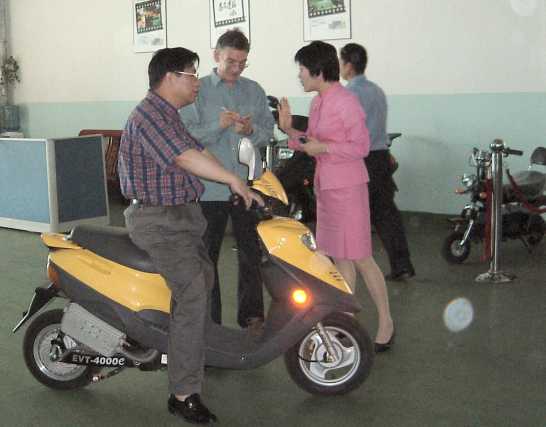
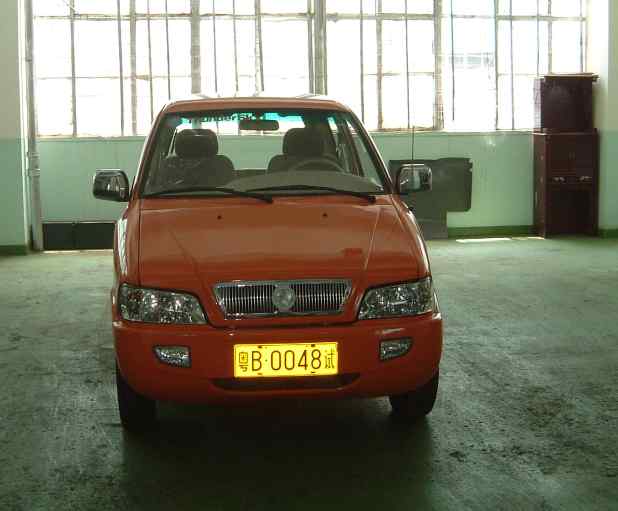
All of the vehicles they had on show were produced by TS as demonstrators for their Lithium battery technology (either converted from more ordinary electric vehicles or from IC-engined vehicles) and as they pointed they are battery producers not vehicle manufacturers - more's the pity. We were also shown some of their battery packs under test and awaiting dispatch.
They did show me an architectural model of their new purpose built factory and facilities but I forget exactly when they said they would be moving there - though I think it was later this year or the beginning of next.
Anyway, my impression was they had all been very happy to see us especially because of my work on the Jester with their batteries - and certainly when I gave Mr. Chung my card - with its picture of the Jester on the back - he was delighted and really chortled at the sight of it.
All too soon we had to leave as we had an overnight train to catch but we got to ride in yet another electric coach - a 20- seater this time (OK - Mao's car wasn't that big!). Again it was nipping in and out of that Chinese traffic with the sort of acceleration and performance anyone would be proud of.
As a footnote I should add that during the rest of our time in China we saw loads of electric bikes and electric scooters, which, though not a huge percentage of the total two-wheelers, still represents a large market. I don't think we saw any electric cars or coaches but it's difficult to be certain of course.
Like all of you at EVUK, I am desperately keen to see some movement on the EV front and look forward to seeing a viable EV on the market and available to all. So I've been trying to contact electric car manufacturers in China and will also be looking at the Haixingma sports EV you mention, but so far my enquiries have not been very successful. However, judging by the response from your article about the Jester, I have no doubt that there is public demand if I can just find a way of getting the Jester and other decent EV's produced and whilst in China I was also looking to find leads on actually getting cars manufactured there.
(Steve Green, August 2004)
Thunder Sky homepage
August, 2004
Chinese electric sports convertible from Haixingma
- is it for real?
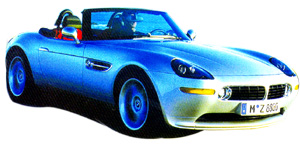
- Well, we certainly hope so..but we don't know so for sure. Yet.
Haixingma Electromotor Co. have contacted us to tell us about their range of EV's - which includes e-bikes, e-scooters ...but most jaw-droppingly of all - this sublime, no name sports convertible.
- But the company have so far been more than a little EVasive as to the vehicle's exact specifications - refusing as yet to be drawn on such minor details as battery range, battery type, top speed and recharge time!!
- So we can only tell you(and Haixingma if you're listening..) about the kind of performance we'd like to see from this racy little open question open-top EV: 150+ miles per charge, 75+ mph and the whole package powered (probably)by advanced li-ion and(probably) by Thunder Sky Cr-F-Li - given that both companies just happen to be located in Guangdong Province.
- So a note of optimism and a note of caution: it may just be that we're being taken for a ride here but, heck, at least:
a) it's an environmentally-friendly ride ...and
b) we get to showcase the kind of EV that would fly out of showrooms - if price and performance are right.
- In the meantime, while our own enquiries continue, why not join in the fact-finding foray by emailing Haixingma at: hxm@hxm.com.cn
Related links:
1) Chinese Ministry of Science & Technology(MOST) developing new generation of Lithium-powered electric vehicles before 2008 Olympiad - see Lithium Hotlinks.
2) EV's, China and the "Axis of EVolution" - see EVUK report.
July, 2004
BBC1 "Global WarNing" Special(28-30 Jul) - is the Beeb biting the bullet at last?
- Or are they still dodging it?
( Update! Here's our post-show review/verdict)
- The signs are not good: from the BBC website programme description it would appear, yet again, that the entire focus of this 3 x half hour, far-from-primetime(12.30 pm ie. mid-day) Climate Change Special will be on effects and causes - not on solutions, not on action...not on eco-innovation, eco-technologies and eco-initiatives in the UK or around the globe.
- So prepare, I suppose, for yet more footage of melting glaciers, floods, extreme weather - interspersed with interviews with concerned climatologists in exotic locations...
Here's that BBC website "Global WarNing" programme description:
"A BBC News special presented by Sian Williams and Bill Turnbull looking at how climate change is already having an impact on people's lives across the globe.
The British Prime Minister, Tony Blair, says 'the single biggest long-term problem we face as a world is the issue of climate change. The evidence now is overwhelming.' BBC correspondents will report live from those remote parts of the world which are already being affected by our changing weather, including China, Alaska, Spain and the Maldive Islands.
They'll examine the evidence that melting glaciers, rising sea levels and expanding deserts are already having an impact on the environment, tourism and economic growth. The BBC Weather Centre will provide forecasts on how the world's climate could change over the next few decades and senior scientists will discuss the latest research on why the world is getting hotter. "
Update! Here's our post-show review/verdict:
The first two editions
were exactly as we expected and predicted - but in the final instalment things began to warm up - even heat up - as the focus finally shifted from effects and symptoms (and blaming America..) to solutions such as alternative energy, clean(er) vehicles etc. 




 Oh dear Richard...EVUK had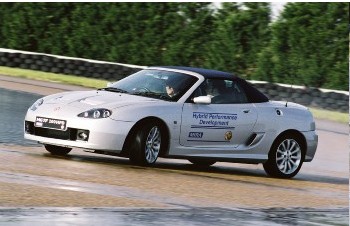
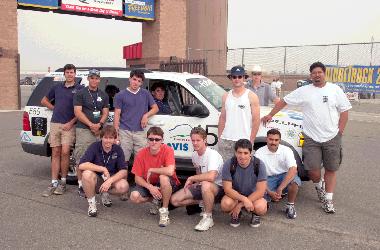
 "Easy EV" - à propos airline entrepreneurs.
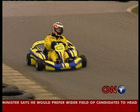
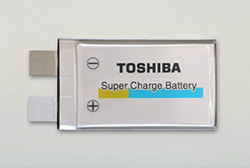
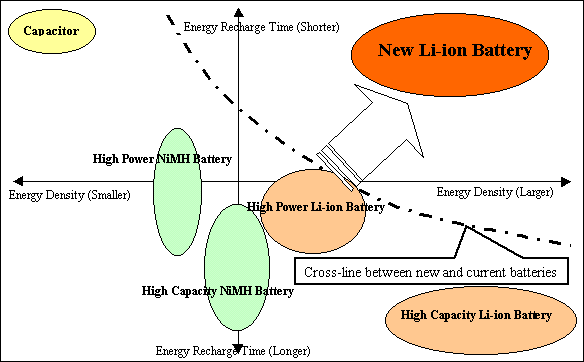



 It may be our imagination - or just plain wishful-wistful thinking - but this
 As it turns out, the cover story's author Andrew English - one of two UK motoring journalists for whom we do have a certain respect(Jesse Crosse is the other..) breaks media ranks and delivers one of the most blistering indictments of the motor industry we've ever seen. At the end of the piece (

 Our fellow EV-insurgent Bill Moore of EV World may have just pipped us to the
 - Hanks appears on Letterman Show to plug electric vehicles(..and his new film Ladykillers)
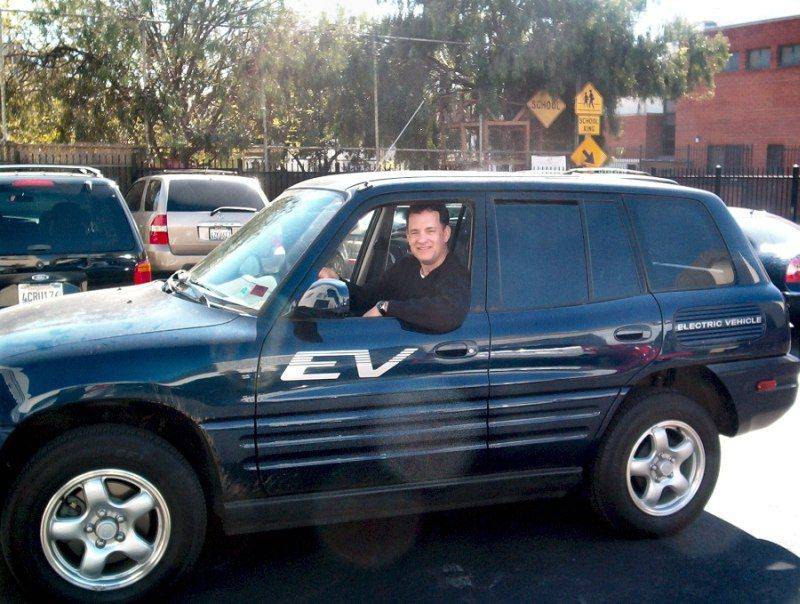
 Firstly - thanks Hanks for daring to 'come out' on live, globally franchised TV as an unapologetic, full-blown practising EV-angelist and RAV4 EV devotee.
 .
.
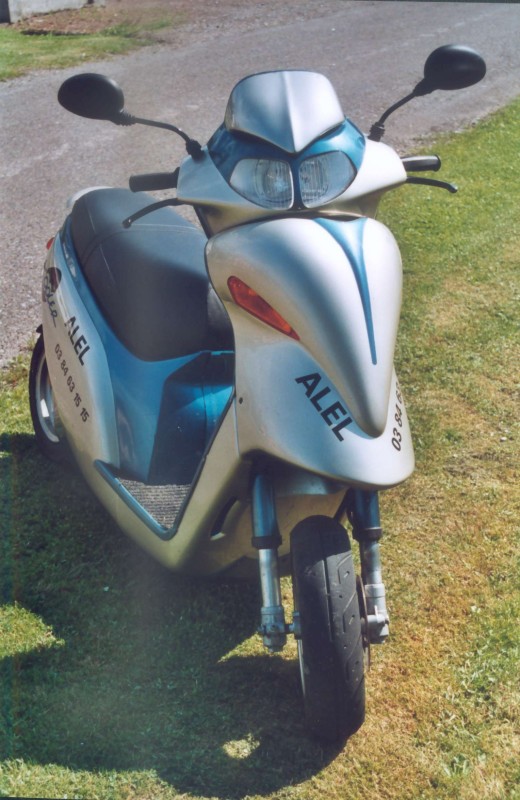 Isn't it amazing just how far a little French flair and savoir faire can go?


 .
.
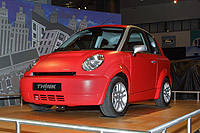 TH!NK Norway's Michael Eimstad recently contacted EVUK to update us on the TH!NK City EV following the sale of the company to Kamkorp last year.
 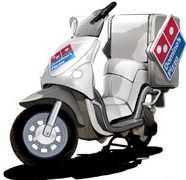 We recently received the following pre- press release mailshot from Raffaello Locatelli of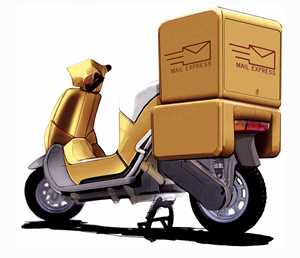

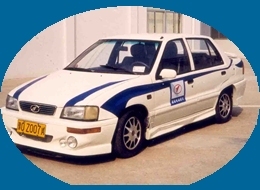 - EVUK was recently contacted by this company with a (very lengthy!) press release and full, extensive details of its Electric Vehicle Development Program. (As reported last year, the Chinese Goverment has wisely decided not to put all its eggs in the fuel cell ZEV-basket - but will also be investing heavily in the rapid development of advanced (lithium) battery-powered electric vehicles - see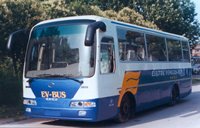
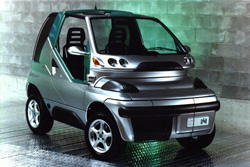 ZAP announces triple-performance, freeway-capable EV's at Las Vegas Show.(Jan 2003)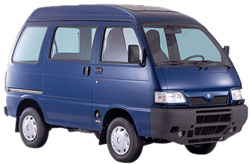
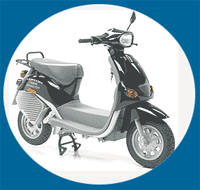
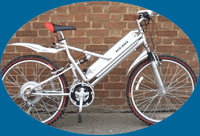
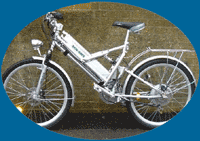

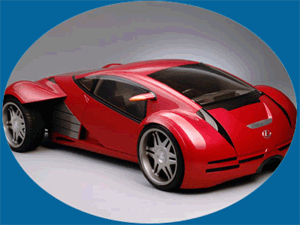

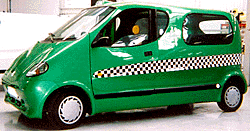 As reported earlier, this �6,200 (+VAT) eco-wonder will go on sale worldwide in January 2002. One car every 56 minutes will come off the production line at the research centre in Nice, France. This N.I.C.E (No Internal Combustion etc)
car has attracted massive global interest.
As reported earlier, this �6,200 (+VAT) eco-wonder will go on sale worldwide in January 2002. One car every 56 minutes will come off the production line at the research centre in Nice, France. This N.I.C.E (No Internal Combustion etc)
car has attracted massive global interest.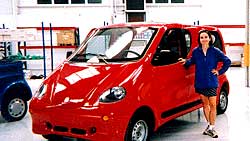
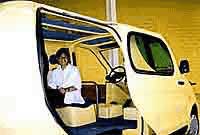 These entrepreneurs unsurprisingly have no connection with the automotive industry.