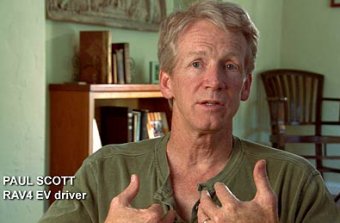
CNN Asia's Eco Solutions: Eco Elvis, battery-swap EV's in Nepal, Green Tomato cabs in London
Eco Solution - clip 1: Eco Elvis's heart-rending "Compost Hotel" - a 100% recyclable version of the heartbreaking original.
Sigh! So many "treading water till 2010" EV press releases to wade through - eg. Tesla to build saloon in CAL, Mitsubishi to partner with Peugeot etc ...
... but sorry - all of that has been totally eclipsed for us this month by Eco Elvis's stunningly hilarious double-whammy star-performance on CNN Asia's special July edition of Eco Solutions(a very rare gem of a green TV series formerly titled Global Challenges and highly recommended by us several times us over the past 3-4 years....).
What's more, this month - to kick off CNN's Going Green week - the show was for once(by popular demand?) broadcast primetime in Europe(19.30 CET Sunday). Here in the West it normally occupies what statistically must be the grimmest graveyard slot of the entire TV week - Mondays at 05.00 UK time - presumably to ensure that only the most environmentally dedicated and determined of viewers will tune in and thus minimizing the risk of corporate-political blowback.
Eco Solution - clip 2: Eco Elvis sings "Viva Las Vegans"(At 5:25 - fast Forward past Biotour Bus and Heartbreak/Compost Hotel - Viva Las Vegans clip sadly not yet Youtube'd). OK - while this song may have little to do with electric cars, it is an astonishingly brave piece of free speech corporate television from CNN's Asia affiliate - and we will need all the free speech TV we can get if we're to stand any chance of preventing EV's being used as a 'fool most of the people' pretext for building hundreds more CO2 and waste-burying coal & nuclear power-plants around the globe(..not that the majority of Johnny-come-lately EV fans and converts seem to give a dime or a damn about anything except high gas/petrol prices ...)
Eco Solution - clip 3: Nepal(Katmandu) battery-swapping electric minibuses.
Footnote: in 2001 EVUK met up with two very optimistic leading Nepalese EV activists in a West London electric bike shop. But getting electric transport onto Nepal streets has proven to be more of an uphill struggle than any hitech-assisted stroll up nearby Mount Everest.... See Shree Eco Visionary homepage
Eco Solution - clip 4:
Tom Pakenham of London's Green Tomato Cars(cabs) - still no word on long-promised plug-in Priuses however ...
Base Notes: Eco Elvis homepage. Monty Python, Mom and Pop were seminal influences says the man behind the mask - Matt Riggs. Why not put Eco Elvis on your personal "Watch List"? (After this subversive CNN performance the NSA almost certainly have..)
Personally we'd like to see Eco Elvis hook up with Reverend Billy(clip) and the
Church of Stop Shopping's glorious Gospel Choir(clip)
And perhaps Neil Young could lend them his Linc-Volt for the video shoot - with the evergreen Blues Brothers at the wheel - this time on a (carbon-neutral) Mission from Mother Earth ...
CNN Asia Eco Solutions homepage. Let's face it, no UK, European or US-based major TV company(especially not the BBC !) would ever dare to air Eco Elvis singing "Viva Las Vegans" - so why not email Eco Solutions at ecosolutions@cnn.com - as we have - urging them not to be cowed by the Meat Lobby or any other corporate bullies, lobbies etc. who may try to persuade or force CNN to water down its undiluted green solutions ?
Still confused, non-plussed, sceptical ?
As in "I haven't heard Paxman - or any other smooth-talking, smart-suited political pundit - discussing "CSP" on BBC Newsnight - so it can't be true".
This must surely be some kind of far-fetched. far-out, wacky, hippy, new-fangled, New Age nonsense - or everyone would be talking about it, right?"
Well - think again. And if you need Hollywood visuals or tabloid imagery to fire your imagination - then think perhaps of Christopher Lee and "The Man with the Golden Gun"(you see - we're not talking silver bullets here..) - and recall Scaramanga's awesome solar-powered secret weapon the Solex Agitator.
The following eerily topical wikipedia 007 plot-extract may jog the memory: "Scaramanga was hired by Hai-Fat to assassinate a British scientist named Gibson, thought to be in possession of solar energy information and technology crucial to solving the energy crisis. Gibson is assassinated and his invention, the solex agitator, is stolen from the crime scene...".
Well, we know of no CSP-related assassinations in the real world to date - but this fantasy-turned-reality, laser-like technology might just as well be "Top Secret" as far as most people are concerned: Concentrated Solar Power is still - scandalously - being denied the regular primetime oxygen of publicity it so clearly deserves in the context of $150-a-barrel oil and a planet in peril from climate change, vanishing resources, the threat of nuclear annihilation and - above all - from weak, lobbied-to-death political leadership.
But hopefully, with the help of a few million informed solar activists - solar agitators if you will - that familiar drumbeat "consensus"(fuelled largely by willful ignorance and lazy group-think) that "nuclear must be part of the energy mix" could soon be blown apart as CSP - Concentrated Solar Power - continues to prove itself in the real world and on an ever more impressive scale.
Main links:
DESERTEC - TREC(Trans-Mediterranean Renewable Energy Cooperation) homepage. Clean Power from Deserts.
While it is true that a number of quality TV/press reports about CSP/desert solar have appeared over the past few years, the subject is still - conspicuously - not being woven into the day-to-day 'need for nuclear' mainstream debate.
A highly efficient, high-voltage('HVDC') Supergrid would transform N.Africa(energy, desalinated water,economic prosperity) and help power all of Europe - day and night.
Sustainable security - avoiding a "Nigerian Nightmare" scenario: the technological challenges have now been met - the key challenge will be to ensure that the ordinary people of N. Africa genuinely reap the rewards - and that energy revenues do not end up in the hands of a wealthy powerful elite - as is so often the case in oil and gas-rich regions of the world.
" I thought long ago you could change the world by writing songs. But you can't change the world by writing songs. Oh, you can inspire a few people, get some of them to change their thinking about something. But you can't change the world by writing songs."
"But we could change it with this car."
The legendary Canadian(still !) songster and activist's 2007 worldwide hit "Let's Impeach The President"(official video) seems to precisely prove the "singing in the wind " point - but let's dare to hope that Neil's new-found EVangelism and - talking of unimpeachable presidents - Lincoln Continental hybrid H-Line conversion will help to change a lot more than just the way we drive.
Young has renamed his car the Linc-Volt - so is clearly aware that GM and others 'got there' before him. The Unique - or Unusual - Selling Point here of course is the legendary singer's back-to-the future focus on soulful classic cars. The times are they a-changin' - at last?
(Click for full Dylan Youtube track - and see Dylan-Obama postcript below)
- Talking of Lincolns and presidents and changing the world - perhaps Barack Obama might think about leaving the campaign bus once in a while and cruising the neighborhood instead in a Linc-Volt emblazoned with suitably 'customized' campaign slogans :
"Driving CHANGE we can SIT in"
"It's the FUEL economy stupid !"
"Elect Electric - vote for a green, black White House"
"100 mpg Lincoln - of the people, by the people, for the people " (Gettysburg Address,adapted)
And since it was Lincoln who abolished black slavery, the Linc-Volt seems a perfect, symbolic match-up.
But then again - given what befell another president* in '63 in a Lincoln Continental convertible in Dallas - maybe a bomb-proof version of H-Line's "Hummer-Volt" would be a wiser choice. (*OK, Obama isn't President yet - like many, were jumping the gun a little here)
Videos links: Video 1: Neil Young driving Lincoln - and explaining "why electric?".
Video 2: Neil Young and ace EV customizer Johnathan Goodwin of H-Line Conversions take Lincoln Continental for a spin.
Video 4(June 3, 2008 MSNBC TV) : Forget 100+ mpg and retro time travel: how does 330 mpg sound - Jetsons cartoon-style ? London-Barcelona on just £20's worth of petrol ? Paris for a fiver ? The 2-seater 90 mph plug-in hybrid Aptera is set for launch in the next 6 months.
A stretched 4-seater seems quite likely before long - according to Aptera' s FAQ pages.
...from classic 100+ mpg plug-in Lincoln
...to futuristic 300+ mpg plug-in Aptera - click to watch recent TV report (June 3, '08: MSNBC Nightly News airs over Europe Mon-Fri 00.30 CET via Astra 19°)
Postscript: sixth sense or what ? The above EVUK piece - including the times are they a-changin' ? line - was posted up by us on June 4th - one day before the Times Online broke the exclusive news - in a very rare interview - that Bob Dylan was (more or less) endorsing Barack Obama. OK if we use that word 'spooky' once again ?
Palestinian state-of-the-art EV ? Not quite - but it's getting there....(Click for full video report)
OK - it may not be state-of-the-art(200 km is the claimed range) and the motivation behind it has more to do with personal survival than survival of the planet - but this recently converted electric car has to be the most inspiring EV-related story to emerge from the Middle East for a very long-time.
Apart, that is , from the sustainable green city utopia "Masdar" currently under construction in the United Arab Emirates where electric transit, two-wheels, two feet and 100% renewable energy are to play a central transport role with electric cars playing a (literally) peripheral role.
So - to connect a few dots across the Arabian desert - while 2000 kilometres may separate Arab-Muslim Gaza from Arab-Muslim Masdar(Google map) they are clearly a universe apart - so we can but hope that a small slice of that green UAE utopia (and capital) will someday and some way be exported to the Gazan dystopia (and - who knows - perhaps even to Slough, Swindon & Newport Pagnell).
Deja vu as electric black cabs promised once more(AutoCar reports)
- Yes, it's now almost five years since we were contacted by another very impressive-looking UK EV consortium and told - in strict confidence - that a lithium -powered black cab was in the advanced stages of development. All parties involved also seemed(as so often) 100% convinced that that EV enterprise this time would succeed. But again, sadly(as so very often) the wheels fell off in the home straight and another dead cert EV project suddenly turned dead parrot.
So let's hope that lessons have been learned and that the wheels stay on this time round - the involvement of Smith Electric Vehicles clearly bodes well - as does the target range of 100 miles.
But we are very far from alone in believing that the proposed 50 mph top speed is unnecessarily limiting and unambitious - 60 mph would surely make more sense. (Even the new TH!NK City can reach 62 mph already ! )
Historical note: electric cabs first came to London' s streets in 1897 - New York beat them to it. See original 1897 NY Times article re London launch.
Some related cabbie "Knowledge":
. . Green Tomato teething problems - London' s only 100 mpg plug-in Prius taxi back in service soon. Green Tomato Cars' Tom Pakenham has just sent us this progress report: "Being such advanced technology, the Prius plug-in has not been without its challenges, and is currently with the conversion agents, who have recently upgraded system and software and expect to replace the old pack with the upgrade some time in June. "
Worlds first plug-in(able) Green Tomato - rolling by June ?
. . The Duke of Edinburgh' s electric cab
As journalist and friend of Prince Philip Gyles Brandreth reported in 1999 in the Daily Telegraph:
"The Duke of Edinburgh deserves to be better understood, says his long-time friend and admirer, Gyles Brandreth(....) He pioneered the use of Information Technology at the Palace, and introduced an eco-friendly electric taxi to the royal car pool."
Stirred but not shaken: yes, there's an ultra-cool way to move in, around and out of a lake - in an all-electric Rinspeed sQuba for example...or you can do it Bond(or Hammond) -style:
India Times reports
(Note: the Ajanta Group also manufactures low-energy, low.cost lightbulbs, wind-turbines and electric bikes )
As hoped and anticipated, the trickle of EV-related press releases from India and Pakistan appears to be gathering momentum - but less than 1 lakh(£1300) for an electric car ? This time even we feel bound to ask: exceedingly low prices - but at what cost ? (ie.environmental, quality, labour ? )
...and in related news elsewhere - from one developing country to a nation in stagnation and a nation facing sanctions - namely Russia & Iran:
- Iran
No, we have no headlines, no press releases to report here. However this strikes us as the perfect moment to mention that we - EVUK - have been contacted several times over the past 3-4 years by Iranian business entities interested in manufacturing low cost, quality electric cars in Iran and seeking EV partners and alliances in any (presumably, now) sanction-busting country anywhere in the world.
So Shai - Mr. Agassi - given that you, your partners and the many journalists who so eagerly report your worthy Better Place EV endeavours are all so clearly determined to keep politics out of business - how's about helping Iran's ambitions to become part of the ever-expanding green"Axis of EVol-ution" ?
Just imagine - Israel, Denmark & Iran united by a common cause - all singing from the same hymn sheet(so to speak), with politically-charged cartoons replaced by electrically-charged car ads - although in the case of Iran and Israel we're still a little unclear(US='un(u)cular') as to how and where the 'EV electricity' will be generated.
Finally, as The India Times also points out, Australia's Farnow Technologies are also planning to produce low-cost electric cars to compete with the 1 lakh Nano in a joint venture with India's Field Marshal group(see earlier 23 March press release)
Note: Eight years ago, in 2000, Farnow - like so many of us - were rather prematurely optimistic that the EV market was about to take off - esp. in India and China(see Earthbeat Sept, 2000). Of course, as all attentive EV truth-tellers are all too painfully aware, that early optimism was soon dashed by the (deliberately?) misleading promise fom carmakers(Daimler, Honda, Toyota, Ford - but not GM) - and from the media - that fuel cell cars were just around the corner("in showrooms by 2004-6") - and that battery-powered cars would therefore soon be a completely redundant, dead-end technology.
These days it's news - or should be - if an entire week goes by without a press release from certain EV companies - Zap in particular of course.
So, are we destined to suffer the same fate for the next 2-3-4 years at the hands of Zenn's PR department ?(See eg. Autobloggreen's already exhaustive coverage re "80 mph, 250 miles/charge Eestor-powered CityZenn")
Well, we've read all the deja vu / heard-it-all-before Zenn-Eestor speculation(EV newbies: try Googling on "Chaz Haba"..) and frankly we'd prefer it if this time round the media and bloggers alike would simply refuse to play ball altogether - until and unless the two companies are able and willing to offer more than zero-proof, zero-evidence press releases and performance claims. (The phrase "put up or shut up" readily comes to mind...)
In the meantime, the constant drip-drip of endless unsubstantiated press releases over the next 1-2-3 years from Zenn and Eestor could well serve simply to undermine confidence in - and investment in - leading Li-ion battery manufacturers such as A123Systems, Altairnano, Enerdel etc. ie. as in: "Perhaps we should postpone/revise/cancel our decision to purchase from A123System, Altairnano etc - Eestor may deliver something infinitely superior in 2009..."
Just who will have benefited - apart from press release scribes - if the Eestor-Zenn story does indeed fizzle & fade come 2009..2010 ?
Related:
"Secretive Eestor" - compare & contrast GM's refreshingly non-secretive, open-door policy towards the Volt - see US Daily report(April 3, 08)
Jay - don't mention the Tzero..or the French Fetish ! (heck - no-one else does!)
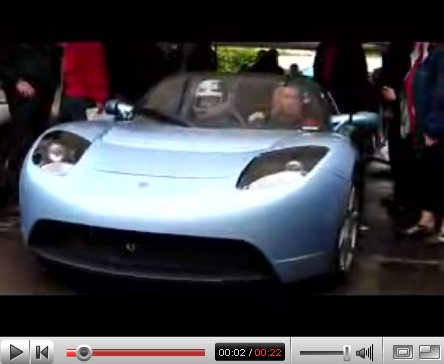
This is probably the most entertaining, high-profile 2008 Tesla test-drive video so far - but as always Elon Musk fails to mention the Roadster's Tzero lineage and the fact that the original, all-enabling, all-inspiring battery and drivetrain platform/solution was created and licensed to Tesla by AC Propulsion(Tzero) and that in fact Venturi got there first by a fairly long chalk - but at the wrong price - with the (similarly) Lotus-inspired Fetish.
So we ask again: when, if ever, will Tesla, Musk, Darryl Siry(PR) et al be leaned upon to show a little humility and honesty and come clean about the Tesla Roadster's true origins and the enormous debt of gratitude owed to AC Propulsion and, for that matter, to Venturi ?
Sure, no doubt about it, the $100,000 Tesla is by far the most commercially viable descendant of the Tzero - but put a black Fetish and black Tesla side-by-side in the same LA, London or Paris car showroom at the same price and it really is anyone's guess as to which would turn more heads and open more wallets ...
Here's part of our Q&A with AC Propulsion's Tom Gage - following the 2006 debut of the Tesla Roadster:
EVUK : we're just trying to establish whether the Tesla Roadster - like the Fetish - is indeed employing the Tzero powertrain as indicated on the ACP site? If so , do you know if - or to what extent - it's been adapted or even improved upon? We would be grateful if you could
clarify so we can give the appropriate credit to ACP.(As you can see from our recent 'NICE' EV report, we believe passionately in the principle of 'credit where credit's due'...)
Tom Gage : Tesla licensed AC Propulsion technology and have incorporated some of that technology in their design. So, the
answer is that it is a Tesla drive system that has been developed using AC Propulsion designs and technology. Some of the changes they have made could be improvements, others may lower cost or achieve packaging requirements.
Obviously, since we've not tested their system, I do not know to what extent, if any, it differs from ours in performance and efficiency.
Re-view: EV Trash-talk shocker (Economist, Guardian) :
- Why not sample just the first two paragraphs of these two ultra-typical Tesla articles from The Economist(no less) and the Guardian - and try not to tear all your hair out...
(Warning: you may need the full straight-jacket for the Guardian piece - written nine years after the launch of arguably America's most popular EV ever..the Toyota RAV4 EV, 3 years after the same car's highly successful 4-year trial in Jersey(British Isles), 3-4 years after the limited production 300 mile/charge Tzero sports EV had repeatedly spanked Ferraris & Porsches, 2 years after the launch of the Venturi Fetish, 6 months after the premiere of "Who Killed the Electric Car?" - we could go on and on...)
...and of course Jay Leno's July 2007 Sunday Times Tesla review unsurprisingly betrays the same universal, chronic inability/refusal to accurately report and research electric vehicle developments. (Especially odd - given how Leno clearly prides himself on knowing the precise history, lineage, origin etc of every petrol-powered car and component in his famous garage...)
Our advice? Relocate to rural India, slash costs & price..and sell 5,000 a year globally instead of 50 or so to affluent Londoners
What on earth happened to Global Village Transport's(aka Stevens Vehicles Ltd) original all-important attention-grabbing January 2006 budget EV price projections / promises?
Just why did those promised £4000 / £6000 GVT / Stevens' electric cars ever-so quietly morph into the "from" £15,000 /$30,000 ZeCar within the space of just just 20 months? Similarly, how did the company's promised £5,500 electric van become the "from" £12,500 ZeVan?
For those who may have forgotten - here's a memory-jogging quote from that original 2006 Telegraph article outlining Stevens' / GVT' s ..er..price-busting "affordable EV" ambitions:
"For example, a buyer in an upmarket London suburb might go for a fully-loaded, hard-top, congestion charge-exempt diesel/electric hybrid version at £8,000. Alternatively, a leisure village might opt for rechargeable, all-electric, hop-on/hop-off open models for nearer to £4,000 apiece(...) Prof Tony Stevens is the man behind the affordable, planet-friendly vehicles, which will start at about £6,000 in the UK (for the rechargeable, pure-electric model - a stretched taxi version might set you back more than £10,000, a van £5,500). "
The three faces of Mike....
And we can assure you that Mike Rutherford will be as disappointed - privately at least - by this eventual ZeCar/ZeVan price-doubling as we are: you see Mike - or "Car-ruthers" as we affectionately(and exclusively) refer to him - has three distinct journalistic personae, styles - or faces if you will: "Tabloid Mike", "Telegraph Mike" and "TV Mike"(a hybrid hack who plays to the gallery and the stalls...)
Now, "Tabloid" and "TV" Mike have been long-time vociferous campaigners for ultra low-cost petrol/diesel cars from countries like India and China and especially from companies such as Mahindra and Tata. For example, here' s how he greeted the launch of the $2,500 Tata Nano in Auto Express magazine in January:
"January 10, 2008 must go down as one of the most glorious, significant and genuinely important days in the history of the global motor industry. It was also a good day for common sense and consumer power. The 10th was when the Indians finally arrived on the world automotive stage. They tore up the motor manufacturing rule book, and revolutionised showroom pricing policy around the world and sent shivers down the corporate spines of American, European, Japanese, South Korean and Chinese firms, which must now respond."
Finally, for the record, as we mentioned at the top, "Telegraph Mike" cunningly, shamelessly, downright dishonestly(Mike - chat to D. Tel' s Honest John ?) claims a breaking news "exclusive" in his latest belated ZeCar / ZeVan "launch" piece titled Electric Avenue"(Daily Telegraph Feb 29)
Sorry Car-ruthers old boy - but we got there 4 months ago(see our genuinely exclusiveOctober feature ):
Yes indeed - in October 2007 we were approached by Tony and Peter Stevens of Global Village Transport/Stevens Research and invited to exclusively report the launch of the Zecar & ZeVan. And - as loyal EVUK' ers will attest - we happily obliged: see our 100% exclusive "UK Breaking News Exclusive: GVT EV's are GO !"
What' s more, to ensure that the news raced round the planet, we followed up that article with multiple mailshots to most major media outlets in the UK - including Mike Rutherford' s very own Daily Telegraph and Auto Express.(EVWorld and Autobloggreen were also on our mailing list)
But despite our efforts, the universal andheresy unanimous response from all parties contacted was...silence - total tumbleweed if you will.
Undeterred, we fired off another mass mailshot a few weeks later asking why no-one was reporting our hot ZeCar/ZeVan launch story. More tumbleweed.
Related news(March 4 2008) Reuters:
Conrad Black - Daily Telegraph owner(1986 - 2004) begins six and a half year jail term in Florida for fraud and obstruction of justice(read Reuters article) ...
Ah yes - you just can' t beat the good "old" media for exclusively good judgement - can you Car-ruthers?
(Perhaps Conrad "The Conman-Convict" Black should have spent more time with Honest John as well...)
Postscript
Moving jobs to India - environmental heresy?
Sorry, but we don' t slavishly subscribe to the obligatory, patriotically correct dogma that keeping jobs in Britain is necessarily always the greenest or most ethical option.
Consider the following jobs in Wales v jobs in India pros and cons:
- Car-owning employees in Wales on eg £23,000 a year will typically have a carbon footprint around 10 times that of workers in India.
- Most car-owning employees in Britain will drive to work if they live more than a mile away.
It may come as a surprise to any Americans reading this, but most UK car-owners(outside London) now use their cars for almost all "journeys" over half a mile.
By contrast, in India most workers will of course happily cycle or walk a couple of miles to work.
- Average earnings in rural India are around $1.25 a day. For just $5-10 a day Indian workers will be able to feed their families and even send one or two children to a half-decent school. And, again, in stark contrast to Wales and the rest of Britain, most children in developing countries would happily walk or run or skip a few miles to a good school - any school(that' s right - no need for a lift from mummy because the roads are so fwightfully dangerous...)
- Indian employees do not use 6-10 plastic bags to get a trolley/cart-full of overpackaged, globally-sourced groceries from supermarket check-out to over-sized car parked just 50 yards away.
- Neither do they routinely leave 3-4-5 domestic appliances on standby for six or more hours a day.(The list goes on...and on)
- And crucially, manufacturing and cost-cutting in India - with the right environmental and quality controls in place - would make EV' s affordable and attractive to millions of people.
The main objective must surely be to displace as many ICE-powered vehicles as possible - not just to run yet another modestly successful green chic niche EV business for the benefit of yet more loaded Londoners seeking to avoid congestion charges and public transport.
Postscript...to above postcript(!)
Two weeks after we posted up the above "moving jobs to India" postscript, Canadian EV company Dynasty has announced(see 31st March report) that they have just sold the company to Pakistani carmaker Karakoram Motors who aim to ramp up production from 30 vehicles a year to 5,000, substantially cutting labour costs and selling to the US and Europe. Hopefully prices to consumers will be reduced significantly as well. (Reducing labour costs without cutting prices simply in order to maximize profits and profit margins is obviously not at all what we' re recommending here...)
Of course many of us expected the CNG-powered hydrofoil Splash to surface in a Bond film at some point(it made the British Aquada look pretty ordinary and slow: video) - sadly, Pinewood bosses still seem as fundamentally devoted to the Internal Combustion Engine as their planet-trashing public service co-religionists at BBC TV' s Top Gear.
On March 6th the first diving car sQuba will make its world premiere at the Geneva Motor Show - we suspect that the Most Frequently Asked "Q" at the Rinspeed stand will be: "So - have you never, ever been contacted by..you know who with a view to..you know what ?"
There are of course those who will tell you that neither Bond creator Ian Fleming - who also wrote Chitty Chitty Bang Bang - would ever have swapped the pumping, thrusting, throbbing petrol engine for silent sci-fi stealth and zero emission Zen.
But ten years ago most people would have said the same about Schwarzenegger and Clooney (see True Lies & spies, Tesla, Tango) - but somehow both Arnie and George have survived their once unimaginable EVangelical conversion with masculinity and virility fully intact - and their Hollywood/political careers in cruise-controlled hyperdrive.
So come on Pinewood - who are you gonna go with ? The Governor of California, an Oscar-winning United Nations Peace envoy(Clooney) and a UNICEF Special Representative(Roger Moore) - or Jeremy Clarkson and Richard Hammond?
Video: Watch Rinspeed sQuba in 007 meets Mission Impossible action
Video: Watch Rinspeed hydrofoil Splash in real-life fantasy
Video: Watch Roger Moore drive pre-Tesla Venturi Fetish
Video: Watch Chitty Chitty Bang Bang float on water
The filming of the latest Bond movie "Quantum of Solace" is underway as we speak - but don' t expect a quantum leap on wheels just yet...
Quantum Technologies(sadly no relation)
(19 Feb 08) press release: "Quantum awarded $14.5m to advance and integrate Q-Drive plug-in hybrid system for 4-door Fisker Karma sport sedan"(pictured below)
So - we' ll just spell out that spooky coincidence of names again for anyone(esp. at Pinewood) who may have missed it:
"Q"
Drive
Desmond Llewelyn(video)
Quantum
- yes, this is surely just the kind of smart and perfectly-named drivetrain that Q himself would have conjured up - providing 50 miles of silent stealthy battery-mode operation ...clearly ideal for all manner of day and night-time undercover activities.
See Daily Mail' s & Daily Telegraph' s almost identical rave reviews(no mention, however, of the 3-wheeled ZAP Xebra...)
Yes, forget the ZAP Xebra(Reliant Robin lookalike, inset) - this really is the affordable, long-range, performance 3-wheeler we would ALL like to see beating Porsches, BMW' s - and the congestion charge.
But a cautionary note on that optimistic, "mathematiclly correct" £15,000 price($30,000) that everyone in the UK is citing using $dollar-£sterling exchange rates ...
Unfortunately, we all know it never seems to work out that way in practice: that mysterious 30-60% $-£ price premium always still seems to be added to any and every dollar-priced product you care to mention by the time it arrives in UK shops or showrooms - no matter how low the dollar goes.
Take the Toyota Prius for example: in the US the hybrid has an MSRP of : $21,100 - $23,370 (See: Toyota US Prius price pages ) ...
...compared to £17,777 - £20,677 in the UK !! (See Toyota UK Prius price pages)
In other words, if you take or transfer just £12000 to the States you will be able to purchase a brand new Prius - but to buy the same model in the UK you will need another £6000 or so!
Footnote re 3-wheel configurations. 2:1 versus 1:2. Rule-of-thumb: for style - choose 2:1. But for 4-seat and/or 4-door practicality and/or unique comedy prop value - always opt for 1:2.
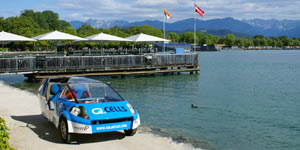
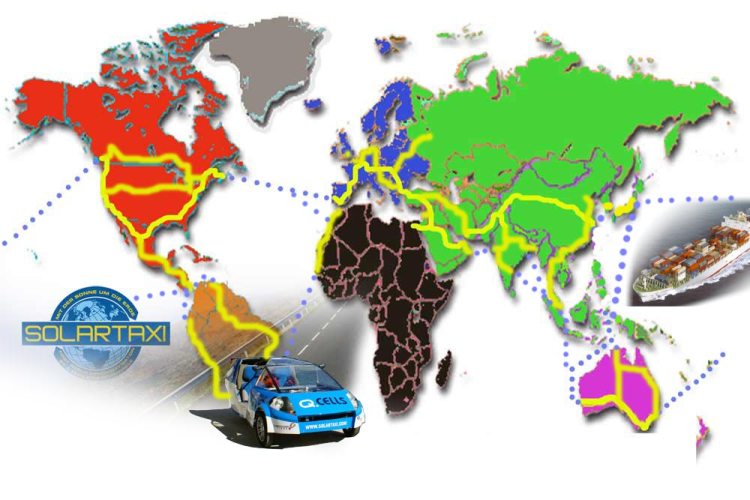
We know of no exceptions to this general rule: 2:1 wheel configuration allows the square-jawed, familiarly stylish look of a normal car - whereas the 1:2 (Reliant Robin, Zap Xebra ) solution always produces "chinless wonder" comedy value. (The 3-wheeled (2:1) 2-seater Solartaxi, like the ZAP Alias, also passes the style test with flying colours of course...)
Can anyone spot a pitiful, power-less elephant anywhere?
Yes indeed, it' s time to break the deafening silence as, all too predictably, not one of the fifty or so Agassi-Israel January news reports we' ve read has connected those most inconvenient of dots ....
To take a leaf out of President Carter' s book Palestine: Peace Not Apartheid: - if, under apartheid, the South African regime had announced a green, ethical initiative for the production of..er.. organic goats' cheese on Robben Island - just how excitedly and apolitically would you have wanted the world' s media to report the wonderful news?
And one other question that begs to be asked but which no journalist has so far dared to put to Agassi and his Israeli backers: namely, will the Project' s recharging infrastructure extend to Israel' s 200-plus settlements and outposts in Gaza and the West Bank? Ooops...
But we can of course imagine a far better place for Shai Agassi's grand EV Project:
Hawaii for instance.
EV Rapid Charge point on Hawaiian Island of Oahu
It's surely a no-brainer: Hawaii is much closer to home, ever-so slightly less politically charged and a tad more peaceful than Israel and again, unlike that country, is officially an American state(the 50th).
What' s more, the Hawaiian islands did once have an outstanding record of EV enterprise and (pro-)activism - until, that is, electric cars and EV programs were famously killed off in the US around 2003 - eg. see for instance Honolulu Clean Cities Electric Vehicle pages, map of proposed Honolulu Rapid Charge Network and Hyundai-Enova Hawaii EV joint venture.
The £1300 Tata Nano( CNBC video) - it could almost become a universal price-squeezing yardstick - an embarrassing, comparative unit of currency if you will:
"What - £16,000 ?! I could buy twelve Nano' s for the price of just one GVT ZeCar...You must be joking!"
Or: "You cannot be serious - 400 measly Watts of overpriced solar panelling for the price of a Nano, a brand-new, (relatively) eco-friendly 4-door family car ?"
Ah yes - alas and a lakh - the €1700 Nano is the best of news and the worst of news all right.
Tata Air? EVUK's Moira G. inspects MDI Air Car in S. France... in 2001(!)
But so much has been said and written about the Tata Nano already
- although, strangely, three weeks "after Bali" no-one seems to be probing the car's precise CO2 emissions -
we'll limit ourselves to reminding everyone that Tata are also planning to manufacture both Guy Negre's MDI Air Car(click image for MDI press release) as well as hybrid and pure electric versions of the Indica saloon over the next couple of years.
Exactly how many "Nanos"/Lakhs each vehicle will sell for is yet to be revealed however.
In the meantime - while a (bio)diesel version of the Nano is in the pipeline, blogs are naturally a-buzzing with calls for a state-of-the-art, price-busting electric version of the Nano.
But so far Ratan Tata has only said this much:
"Down the line, as we widen our range, we will have dressed-up versions with higher-powered engines, diesel engines, automatics and the like. We have a whole bunch of innovations coming along on this platform." (Source Tata.com"The Making of the Nano")
And as the Solartaxi and Greenpeace Rainbow Warrior arrive in Edmund Hillary' s famously green homeland of New Zealand, it's probably not surprising that one of the most balanced Tata Nano reports we have read thus far(and we've browsed at least fifty ) appears in both The Independent(with video) and the New Zealand Herald: "Environmental Concerns Over Cheapest Car".
Yes - forget all those Tesla roadster and record-breaking electric dragster clips...and the river of press releases promising "Li-ion EV's by 2009-2012"(12-15 long years after the launch of the RAV4 EV) - this Solartaxi-Bali video is not just our personal favourite - our "EV Video of the Year 2007" if you will - it surely must rank as one the most environmentally inspiring EV news items of the last 12 months.
- Watch CNN's Bali Solar Taxis(sic) report(quote): "..solar-powered taxis(!!) transport delegates"(Warning: this CNN clip is incongruously sandwiched between two uber-macho motorbike ads)
Tabloid footnote: it seems Ms. Jagger invited Solartaxi's Louis Palmer back to her hotel for a post-drive drink - but, alas, our energy-saving hero was far too tired for the task...)
A little over nine months ago(see EVUK March 2007 article) Eddie Kehoe of the Electric Transport Shop in Cambridge admitted that although they'd had the lithium powered version of the Powacycles - the £590 Salisbury and Windsor LPX models - in stock for a few weeks they hadn't at that point sold any: "..most customers are still going with what they know - NiMH - rather than li-ion. A year from now the lithium Powacycles may well have proven themselves to be just as reliable and durable as our tried and tested NiMH bikes - only time will tell."
And indeed the good news, nine months later, is that sales of the lightweight Li-ion Powacycle Windsor and Salisbury(pictured) LPX as well as the even cheaper (£449) Synergie Mistral have gone through the roof - the company has now sold well over a hundred of the bikes since we first spoke to them in March.
And it gets better - they recently opened a second outlet in London and will soon be expanding to Oxford and Bristol - making them "the largest independent retailer of electric bikes in Europe."
Of course neither we (or Cambridge graduate Eddie) are claiming that these ebike are the best buy for everyone: if, for instance, you're facing a 10-20 mile uphill, against-the-wind commute every day and happen to have £1245 pounds to splurge it's generally agreed there are few bikes out there to rival the Presteigne-prize-winning Ezee Torq(see 50cycles Torq and video)
But despite soaring ebike sales, Kehoe seems even keener to talk about his latest £650 slimline li-poly(1000 full charge cycles) ebike conversion kits(below) - which he rates even more highly than the more expensive and well-known Heinzmann or Bionx models.
Our only criticism of the new kit is the battery position ie. integrated into an obligatory rear-rack. Obviously a less conspicuous down-tube location(like the Bionx's "water- bottle" battery) would also provide a lower centre of gravity and appeal to those (younger, image-conscious ?) cyclists who don't like racks and wish to preserve their bike's original appearance and style.
Frankly, we look forward to the day when all ebike(trike, tandem,recumbent..) kits are provided with universal fixing clamps/brackets allowing batteries to be located more or less wherever the owner chooses(like the Akkubike for example).
Here' s a key extract: "The breakthrough is described in a paper, "High-performance lithium battery anodes using silicon nanowires," published online Dec. 16 in Nature Nanotechnology."
"Given the mature infrastructure behind silicon, this new technology can be pushed to real life quickly...The greatly expanded storage capacity could make Li-ion batteries attractive to electric car manufacturers."
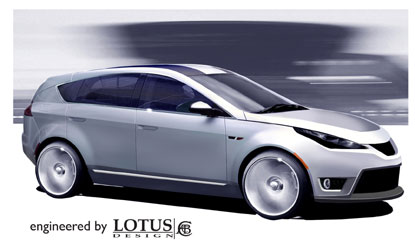
1) We were contacted in November by the organisers of the 2008 British International Motor Show seeking our suggestions as to potential EV exhibitors for an "EV Pavilion" which is to feature for the first time at the July 2008 event at London's Docklands Excel. And whilst we have of course dispatched our own shortlist - which included a heavily question-marked Tesla-Lotus (???) - all serious EV entities wishing to participate should either contact Luke Perry at IMIE Ltd - or email us.
2) Zap's recent claim(see Forbes, CNN Money and ETA) that their 3-wheel Xebra is the first 4-door electric car to get full UK approval is at best unwittingly misleading - at worst deliberately mischievous - Global Village Transport UK s 6-door and - perhaps more importantly 4-wheel 60 mile/charge, 60 mph ZeCar unveiled in October and reported exclusively by us
ZeCar(left) - full UK approval well before Zap Xebra...
was fully approved for use on UK roads earlier this year: GVT's Tony Stevens has confirmed this to us and expressed his puzzlement at Zap's widely reported claim:
"We have all the approvals needed from the appropriate agencies, DVLA etc for the ZeCar and ZeVan. The Vehicle and Operator Services Agency that Zap refer to is actually responsible for monitoring Lorry and Bus Operator Licences(!) as well as regulating MOT Test Centres. It sounds very odd. I don't know why they would want their approval for anything."
ZeCar: four side doors plus 2-doored rear hatch - all fully UK approved !
As for the 40 mph, 25 mile/charge 3-wheeled Xebra - sorry guys - it pains us to say it - and please go ahead and prove us monumentally wrong... but we just don't get it - and, frankly, we don't know anyone this side of the pond who does.
But then again, in congestion-charged London anything goes that's green - and given the right PR, pricing and paint-job - well, who knows?
But, for our money, the infinitely funkier,zappier lithium-powered Obvio !(right, video) is - or would have been - the obvious choice for the whole of Europe - with or without congestion charging. Yep, all in all, this looks to us like yet another case(or two) of "the wrong electric car at the right price...and the right electric car at the wrong price."
3) Hampshire police trial Vectrix stealth scooter - BBC Online plus BBC video here(London Bikers).
Many police authorities have trialled/are trialling electric bicycles of course: but scooters, cars and motorbikes - electric or not - just can't match ebikes when it comes to effective, preventative community policing as Sgt Nick Butler,leader of the ebike police team on the Coxmoor estate in Kirkby(Notts) points out in a PCSO News piece titled "Battle Against Estate Crime Goes Up a Gear":
"We have been using conventional bikes for several years to patrol the neighbourhood, but the additional power of these new cycles gives us that edge on steep inclines and allows us to respond to incidents quicker. Residents like to see us out and about on the bikes as it makes us much more approachable."
4) Sea, Sand & Sun - BFS Biopetroleo(Spain) promises Biopetroleum from algae whilst Desertec promises clean power(and not only solar) to Europe from deserts:
- BFS Spain - Biopetroleum from algae. The end of Fuel v Food fighting ? "Operational in late 2007" - or so we've been told many times: "the system will produce massive amounts of biopetroleum from phytoplankton, in a limited space and at a very moderate cost." - from IPS News. Click BFS "Comunicacion-Noticias" for ten Spanish TV reports.
Sadly though, the news is simply that there is , curiously, no "BFS now operational" news in very "late 2007"...
- Desertec - White Paper presented to European Parliament on November 28, 2007.
Aim is "..to boost the generation of electricity and desalinated water by solar thermal power plants and wind turbines in the Middle East and North Africa (MENA) and to transmit the clean electrical power via High Voltage Direct Current (HVDC) transmission lines throughout those areas and as from 2020 (with overall just 10-15% transmission losses) to Europe.
5) Exxon Mobil promises "safer, more affordable" lithium batteries for EV' s and hybrids. As do a dozen or so other companies already!
But this is not the first time that an oil company has backed the "enemy"(ie. mpg-boosting batteries) of course: see the following December 2002 piece concerning Texaco Ovonics Nickel Metal Hydride(NiMH) EV/HEV batteries amusingly titled: "As EV's Disappear, Texaco Ovonic Remains Bullish on Batteries"
The COLOR of MONEY CNBC TV - the world's leading globally syndicated business channel(audience: 100 million) answers the "eco solutions" call with a week devoted to eco innovation and green business opportunites in the US - don't miss the following TV video clips(and many more..all clips are preceded by very short ads):
Clip 1)
Larry Hagman aka "
JR"/ J.R. Ewing shows off his solar powered farm, his bright red (Lee Iacocca) ebike and one of his five (!) Toyota Priuses(Note: we have it on very good authority that at least two of these are plug-inable...) .
Now how often do you hear the words "electric bike" being uttered on TV here in ever-so Kyoto-committed UK/Europe? Let alone being endorsed by an evergreen A-list "alpha male" celebrity? So just why is the idea of a British(or German, Spanish...) A-Z lister showing off his electric bike on prime time TV so completely unimaginable?
Clip 2) Agassi, Shai. Former SAP rising star Shai Agassi talks about his $200 million funded EV battery charge/exchange enterprise, "Project Better Place".
Battery exchange stations are not a new idea of course and have often been proposed over the past ten years or so - especially in the context of zinc air batteries/anodes - see Electric Fuel's pdf on the subject as well as a video animation of another pre-Agassi battery-exchange concept called 'URECA' - with comments from the patent-holder Jake Hammerslag.
Our view - and the general consensus - is that battery-swap stations are an idea whose time has come and gone. All the indications are that Li-ion battery range/energy density will increase by at least 50 % in the next 10 years and 100% within 15 years.
Conclusion : 200-300+ mile EV range, readily available rapid-charge technology - not to mention Chevrolet Volt-style onboard charging units - will entirely obviate the need for complex, cumbersome and costly cell-swap stations.
So we're far from alone in hoping Agassi & his enthusiastic, influential backers will quickly dump the doomed white elephant cell-swap idea and focus primarily on the roll-out of green energy-based stand-alone recharge powerplants - where possible with a combined heat & power(CHP) component.
Clip 3) Trucks & School Bus Go Green(hybrid)
Clip 4) Silicon Valley is now Green Valley. Includes footage of Google.org's RechargeIT hybrids
Clip 5) Easy Being Green - and very profitable(so far) ...if you take the advice of CNBC' s Jim Cramer !
Clip 6) Ethanol(non-food, cellulosic) in your Backyard - backed by renowned green venture capitalist Vinod Khosla.
Clip 7) Switchgrass - grassoline. Nature's Solar Battery ?
Over the past week CNBC has probably aired more eco solutions/green business reports than British and EU TV companies have collectively broadcast in an entire year- and it looks as if it' ll be a sustained effort. To watch them all - go to CNBC.com or http://green.cnbc.com and there Search Video on keywords such as: "green" "color of money" "hybrid" etc.
CNBC can be received free and unencrypted along with around 3000 other free TV & radio channels throughout Europe using a so-called "FTA"(Free-to-Air) receiver(full system cost: circa £100) via Astra satellite 19° East - or encrypted via Astra 29° for those who actually like paying Murdoch-Sky subscriptions.
...and don't miss CNBC Europe' s coverage of
The World Energy Congress from Rome(12-13 Nov) - plus Cost of Carbon Week(12-16 Nov)
Finally, if CNBC's green programming is not sustained week-in, week-out - you can always fill the void with these green TV perennials:
1) Living with Ed - Begley's EV-inclusive version of the BBC's EV-excluding, short-lived, rarely aired or repeated series "Not Easy Being Green". Watch recent episode in which a friend test-drives Ed's fast-charge Li-ion SUT.
2) Living with Tom !? OK, Tom Hanks isn't yet starring in his own eco TV series - but this upclose-and-personal video of Hanks at the wheel of his eBox EV is definitely worth its 5-Star rating.
(BTW: The eBox comes from the same AC Propulsion stable and shares the same battery/powertrain DNA as the Tzero, Tesla Roadster, Venturi Fetish, Wrightspeed Atom, Zooop...)
3) The Green - on Robert Redford's Sundance Channel
A result! See Gizmag report
Some of you may recall that in 2004 we contacted Mike Whelan, National Manager, Corporate Communications Subaru of America, Inc. to bemoan the - then - poor promised 100 km range of the Subaru R1e. Here's an extract from that 2004 EVUK piece spookily titled: "Japan's battery-powered r-EV-ival - is a lithium dawn about to break?":
EVUK extract - March 2004:
"...what exactly is the R1e's battery-range? Why the big mystery? - Subaru appear to have been deliberately avoiding the whole question of R1e's battery-range and no-one in the global EV community had much of a clue either....so we contacted Mike Whelan, National Manager, Corporate Communications Subaru of America, Inc. - who also did not know! However, Mr. Whelan did immediately offer to contact his Subaru colleagues in Japan...and got back to us the next day with the following official response:
"The projected range for the R1e is 100km(62.5 miles) based on the 10/15 mode which is the Japanese technical standard".
"Oh dear - most EV-watchers will find this 'projected'(?) battery range monumentally disapppointing. And baffling too - given that, for example, the li-ion Nissan Altra and the NiMH Toyota Rav4 EV's - both launched five(!) years ago - already had official battery ranges of 125 miles. So 100 km? 62 miles!? Most of us are now hoping for and expecting something in excess of 250 km per charge from the latest generation of li-ion batteries..."
(EVUK extract: March 2004).
See also: Moira G.'s EVUK exclusive June 2007 video clips(x3) of Subaru R1e at Eco Car World, Yokohama, Japan.
Note: at that event Moira naturally again did not refrain from complaining - as tactfully as possibly - to Subaru engineers et al about the promised paltry 62.5 mile range. Thanks Moira - sometimes campaigning and complaining are two sides of the same coin !
More than twenty-one very silent, secretive months have passed since The Daily Telegraph reported (
"Smarter than a Smart", Jan 2006) Professor Tony Stevens' highly ambitious, mouth-watering plans to develop - and secure City funding for - a range of radically green, affordable and ingeniously spacious("Tardis-like") all-electric and biodiesel-powered hybrid vehicles.(See also our own 2006 report "Global Village Mystery"
During that protracted media blackout EVUK has of course occasionally contacted the company to ask, as diplomatically as possible, if "No news really = Good news" - each time we were relieved to hear(in confidence) that everything was on track if a little behind schedule....
Well, at long last - after (it has to be said) some last-minute constructive nudging and niggling from us - Tony Stevens and his development team have decided to throw the covers off and go public at last - exclusively, in the first instance, via EVUK.
So here is the full 4-part press pack we received yesterday: at this point we'll simply let the photos, pdf files and press release texts(x2) speak for themselves - and keep our own supplementary comments & questions for a later date:
PART I : Introduction, future plans, contacts etc
BACKGROUND:-
The Stevens GVT (Global Village Transport) range of vehicles have been in development for some 15 years. The reason for such a long development time is that we have gone back to basics and created a completely new way of designing and manufacturing vehicles in high volume and at low cost without the usual $Billion up-front investment.
This has been done so that developing communities, not just developing nations, can make for themselves the personal and goods vehicles they need to advance their social and economic development.
The major bonus which has come from this work is that the pollution involved in making our vehicles is dramatically less than is possible using conventional technologies, which now exceeds the lifetime exhaust-pipe pollution for each vehicle, and this pollution is getting worse not better as manufacturers vie with each other to make their vehicles more complex. Complexity creates additional pollution and this is not acceptable any more.
We have to give the developing nations a cleaner way than our 50 year old technologies and the Stevens GVT range does just that.
TODAY:-
In pure electric form, the first 2 models in the GVT range will be available shortly in the UK and the advance order book is open now.
ZeCar - at last a proper electric car. 4/5 seater saloon with excellent luggage space. 10 feet long and the turning circle of a London Black Cab. 0 to 30mph in 8.5 seconds, 0 to 60mph(which is the governed top speed) in 20 seconds. Fully laden 1 in 5 hillstart and a range of 60 miles with standard batteries.
ZeVan - an amazingly spacious and versatile City delivery van with the same technical specification as the ZeCar.
FUTURE MODELS include:-
Short wheelbase (as ZeCar and ZeVan):-
Pick-up
Leisure resort open-sided runabout.
Long wheelbase:-
Taxi
Big Van
Big Pick-up
Limo.
FUTURE TECHNOLOGIES include:-
Diesel/Electric Hybrids using a new ultra-compact diesel engine capable of running on bio-diesel fuels.
new Fuel Cell which is not Hydrogen-based and can be re-charged in 3 minutes.
Solar and alternative power sources for remote operation.
Advanced composite materials.
COMPANY STRUCTURE:-
Stevens Research Limited (SRL) develops and acquires IP in new technologies particularly appropriate to transport and social development and has truly global connections established over the last 40 years. This company owns all the IP for the GVT range and its unique design/manufacturing technologies and has close ties to other associated technologies.
SRL licenses its technologies and products for manufacture and sales to licensees in each country or district in the case of large countries.
The licensee in the UK is Stevens Vehicles Limited.
PART II : CLICK HERE for full official 15th October 2007 Stevens Vehicles Ltd / Global Village Transport PRESS RELEASE ! (Note to editors & bloggers: please feel free to reproduce this press release - however, we would appreciate a courtesy "Source : EVUK" tag/link)
To find out more about ZeCar and ZeVan in the UK and place an order contact:-
Peter Stevens, Managing Director of Stevens Vehicles Limited
Email: peter@stevensvehicles.co.uk
To find out about investing in Stevens Research Limited contact:-
Professor Tony Stevens, Chairman SRL.
Email: tony@stevensresearch.co.uk
Would you like to comment on the above article? Visit Britain's leading - EVUK-linked - EV Discussion, Campaign & Media Watch Group Electric Cars UK.
Eco Solutions(Mondays 23.00 GMT) - the new title almost promises the earth - even more so than its earlier incarnation, "Global Challenges".
But one chronic problem with so many erstwhile "green" TV shows has been their conspicuous reluctance to examine environmental(technological, corporate,political) solutions, challenges, roadblocks here in the industrialised West for fear of ruffling corporate and political feathers at home..
Instead, what we are usually offered is a mix of environmental colonialism and eco escapism - BBC World's "Earth Report" being a typical example - where TV crews happily head off to endless exotic locations to preach the green gospelelsewhere - preferring to train their cameras on environmental enterprise and activities in developing countries - solar ovens in Madagascar, micro-finance in India, sustainable farming in Mozambique, irrigation projects in Tanganyika - sound familiar ?
Anyway, we hope this time round viewers will do what they can to prevent CNN' s "Eco Solutions" taking the familiar "third world" route by emailing ideas to: ecosolutions@cnn.com
Here are a few suggestions we recently dispatched to CNN :
"We'd like to see you putting the spotlight first and foremost on eco solutions and challenges here in the West - in Europe, the US, Australia etc. where per capita carbon footprints are typically 10-20 times what they are in developing countries.
A few suggestions(from 100' s we could rattle off..and may later) :
1) Eco Vox Pop: how about taking a selection of electric bikes and electric scooters/mopeds out into the streets of one or more of Europe's less environmentally futuristic towns and cities - Swindon, Athens, Naples, Benidorm for instance - and asking pedestrians, cardrivers, even people waiting(..and waiting) at bus stops, if they know anything at all about electric 2-wheelers. Have they ever considered them as a logical, fast, low-cost, low-energy(both muscle and grid) transport option - and if not, why not?
And perhaps, CNN, you could arrange to have a petrol moped(preferably with a year or two's piston wear & tear)running and revving near the microphone so the passing populus can more easily see, hear and smell the point of this sidewalk Q&A ? (..a megaphone and oxygen mask may come in handy...)
Then perhaps you could ask - again vox pop-style - whether most people in the West are still making transport choices(ie. car) largely on the basis of such factors as self-image and status? Or perhaps from lack of eco-tech awareness or imagination?
And maybe you could ask this of passers-by:
"If your boss, head-teacher, local MP, vicar, etc were to swap his car for an electric bike or scooter would you see him/her as:
a) An eco hero - if more people were to do the same it would free up road/parking space for me and my car...
b) Odd - an eccentric sad loser who must be suffering fiinancial problems.
c) Someone who wheely walks the walk - who genuinely thinks and acts outside the box - even when outside the boardroom, classrooom etc ... "
2) Or perhaps, CNN, you could investigate, in-depth and fearlessly, why solar panels and solar hot water systems are a far more common sight in Austria and Germany than they are, for example, on the sun-drenched Spanish Costas or throughout most other Mediterranean countries. Are powerful vested interests(energy sector) and weak government still to blame for the gulf between eco rhetoric and eco reality?
3) Finally, CNN, can we propose a discussion involving media "experts" and independent media experts(a very different breed) examining why there are still so few TV shows anywhere in the world with titles like "Eco Solutions" ?
But then again, maybe it would be a whole lot easier just to pack the TV crew off to the airport in the 4x4's and transport them a few thousand miles to magnificent Madagascar to see what the natives(sorry - indigenous people) are up to and take another look at those wonderful solar stoves....
Eco-logical Solutions: where is the oxygen of publicity...the political support...public imagination?(Vehiculos con Ingenio, Malaga)
- Ok , it's all in German again of course - but Loremo CEO and founder Gerhard Heilmaier does confirm that an electric version with a range between 160-200 km"will be available at the same time(2010) as the diesel version. "
Yes - a disappointingly low battery range perhaps - but all that could change of course as global competition fuels further Li-ion advances and price reductions ...
Anti-gravity Loremo ? Is that what it would take for our English-speaking media to break ranks and break their current silence? Yes, the non-German media have so far conspicuously failed to report the rolling Loremo's Frankfurt debut. You too may have noticed that in the past 10 days or so a Google News search on "Loremo" has dished up nothing at all - nix, nada. Even Channel 4 online - which did briefly preview the Loremo in August - is also now
strangely silent. As are Auto Express and Autocar magazines - and much less surprisingly, our own post-Live Earth BBC. But this collective silence seems particularly remarkable given the copious coverage devoted to the impressive-looking & sounding ReVolt - sorry ReCharge - and Flextreme concept-only offerings from Volvo-Ford and Opel-GM respectively. Especially given the fact that - like the ZAP-X and Lightning GT EV's - the ReCharge is dependent on PML's in-wheel motor technology actually delivering on its promise : so far only the Loremo has been tested, demonstrated and video' d on the open road and in the real world - but apparently English-speaking audiences just wouldn' t be interested...
Click for new official Blog and NOW ...watch latest video(Sept 8) of Loremo L1 'spied' on the open road..
In just a few days a working prototype of the 11,000 euro, 117 mpg(24% less than the original 157 mpg) (bio-)diesel Loremo L1 is scheduled to appear at the
Frankfurt Motor Show(13-23 Sept) and EVeryone - well everyone at the newly revamped official Loremo Forum(English version) and sadly nowhere else - is talking and fantasizing expertly - and almost exclusively in German - about the potential for a long-range, low-cost, fast all-electric Loremo - or E-Loremo.
Click for English Loremo Forum
Many highly-informed and articulate advocates of an electrified Loremo have emerged at the Loremo Forum over the past year or so but none of them can quite match the technical expertise, caustic wit and all-round EV-worldly wisdom of Forum contributor "FourofFour" (don't ask!) whose 300+ km/charge, 200 km/h, quick-charge dream Loremo - battery-life 300,000+ km - would likely cost less than €30,000 Euros(£23,000 ) to put together - even less of course if Loremo could be persuaded to sell donor vehicles minus diesel engine and Heath Robinson ICE-support system(click on artist's impression, right, for details).
But precisely how many man hours it would require to build the Loremo dream and exactly what price "4of4"'s family might have to pay along the way is pretty much anyone's guess at this stage...
But what better time, anyway, to share that realisable dream with a global English-speaking audience - just a few days before Europe's hard core of diesel die-hards and crank'n'piston fundamentalists(and that's just the journalists...) gather for this month's electric v. ICE showdown in Frankfurt - surely the last-chance saloon for what remains of the head-in-the-sand, fossil fuel brigade...
So we contacted "FourofFour" - aka "Dr. Martin Schulz - to ask if he'd object to our translating his extremely green dream into English. Within two days he'd done the job - the translation not the conversion - for us. Speculative aside: We believe that an Anglo-German Dream Team consisting , say, of Dr. Dennis Doerffel(REAP Systems/magazine), Cedric Lynch(of Agni Motor and Lynch Motor fame) and Dr. Schulz himself could probably translate this particular dream Loremo into reality in a frantic fortnight - once the (often) nightmarish task of getting batteries , BMS and motor delivered in mint condition had been completed of course.
Click image for all Youtube'd Loremo clips - most recent first. So far only one is in English...
My E-Loremo dream - by Dr. Martin Schulz ...in his own words(with the odd Editorial aside..)
To start with I've been an EV-driver for quite some time now. I own a VW-Golf-CityStromer(built by Siemens-VW in 1995, click inset for details) and as I use the car for my daily commute, I'm totally satisfied with it.
(Ed. see also: 1994 CityStromer for sale, just 2000 miles on clock: http://www.elektroauto-forum.de
I live in Erwitte in the middle of the so called "Sauerland", This is a rather large region in North Rhine Westphalia. I have a Dr. degree which was achieved at the Institute of Power Electronics and Electric Drives, University of Siegen (Germany). I know one or two things about electric drives and my favorite subjects are renewable energies, power semiconductors and inverter technology.
As a technician, technophile, "Ingenieur" etc. I'm constantly thinking that my 62 mph /100km/h VW EV with its range of around 70km(44 miles) really performs very poorly in view of what could be achieved today. Two things are particularly problematic about the Golf of course: weight(1500kg !) and battery technology.
So my thinking is: could I convert a road vehicle available on the market to be a better EV than this?
And would I be a megalomaniac to think that I - as a one-man enterprise - could do better than a whole host of VW-Engineers and Siemens system designers?
The drawback most EV enterprises suffer from was easily identified ie. they reconstruct cars by simply replacing the ICE with an electric motor, throw in batteries and keep the comfort to what "the customer" demands.(Ed: or "what the carmakers et al want the customer to want")
Then I stumbled upon the Loremo. Planned to be highly efficient, low in weight, low on energy consumption with its designers claiming the 450kg car would cover 100km on just 1.7L of Diesel. With almost all of the gadgets gone that make a car fat(not 'phat'...just overweight!)
Fingers to Wikipedia and calculator:
1.7L of Diesel equates to approx. 17kWh of energy. With an efficiency of the diesel engine being not much more than 30% I ended up with about 5-6kWh/100km if driven by batteries - so around 300Km range with the capacity installed into my own car.
Click for English Loremo Forum
From this moment on I couldn't resist contemplating what potential this car would have as an EV and so here's a summary of what eventually became my dream Loremo:
I want this car to go as fast as 200km/h (I live in Germany!) And anyway what is a Porsche-like looking car good for if not for a little hunting and chasing - a little hot pursuit if you will ?(Ed: most of us would be quite happy with 130 km/h / 81mph of course...)
Also, I'm a biker. I'm an acceleration junky and I want the car to reach 100km/h in less than 10 seconds. The more acceleration the better.And I want at least 300km/charge.
So - could I do it? Could anyone do it? Would the laws of physics allow it? And most importantly of all - could I afford it?
I'll divide my dream into four parts: Batteries, Motor,Thermal design, Semiconductors & heat.
Firstly the battery mystery...
Here are my favourites - to date:
Nanosafes by Altairnano
Great on paper and already being used by Phoenix Motorcars of course.
Extraordinary lifetime and cycling capabilities. Price unknown.
One drawback of these is energy density. 1.2kWh in 17kg is very low.
The 15kWh I'd like to have would be 13 pieces with a weight of 221kg.
Despite their impressive capabilities, this is a knock-out criteria.
Li-Tecs
This is a German company building Li-Ion batteries using a ceramic separator.
Their Li-BP-3-0400-24 provides 24V/40Ah, so 0.96kWh per battery at
8.2kg of weight and 5.82L in volume. The 15kWh I want would be 16 of these arranged in a 4x4 array. 96V 160Ah.
Li-Tec states the price for 1kWh would be about 700 but there is no reassurance that this is a valid price if you try to buy these batteries.
Battery cost estimates are about €200. Ouch!!!
With 16*8.2kg the battery weight is "down" to 131kg and volume would be 94L. But the batteries come with one more advantage. A BMS, Battery Management System, is included in each battery so charging can be done with a rather simple charger and I wouldn't have to build the BMS on my own.
The batteries are supposed to reach at least 1k cycles so where would I end up?
If I were to charge 1000 times, every 300km let's say, the battery would last for 300,000km(187,500 miles) still giving me 240km/150 miles per charge. I decided this should be good enough.
A123Systems
This company, up to now, has no large capacity packs but only single cells of small capacities. These are for the reasons given above, not an option for a private conversion. Simply too many cells here.
Still: Their ANR26650M1 has 7.6Wh at 70g of weight. Roughly 2000 Cells would be needed adding up to 140kg of weight and 15.2kWh. Not a big gain towards the Li-Tecs here, right? And imagine the wiring of 2000 cells.....
One more to go:
Kokam - see full Kokam datasheet pdf
This is a Chinese battery manufacturer offering cells with 240Ah at nominal voltage 3.7V. A single cell comes with 0.88kWh of stored energy at 5kg in weight and 2.4 Liters in volume.
I prefer 100V-Systems in an EV, so I would like 27 of these in series.
135kg of batteries giving me 24kWh in just 64 Liters oh my goodness!!
This could do far more than I expected!
24kWh would be enough to easily go 400km/charge. And just one hour to recharge.
240A nominal current at 100Vdc is almost the 27kW I want but I suppose the batterries do not suffer too much from 300A being drained now and then as the company claims the cell can provide 480A peak current.
Or maybe I could reduce the target top speed down to 180 km/h - still good enough to do at least some hunting(German: "jagen") .
With the datasheet stating only a cycle life of ">800" this would get me 400km/charge when new and 320km after the battery is down to 80%.
Up to this point the car would have 320.000km(200,000 miles) on the meter.
Again: good enough - and a BMS for 27 cells should not be too difficult
to build.
Postscript: I just got the price quote for Kokam's 240Ah cell.
590 per piece at 1k pieces. Tough - given the fact that I would like 27 of these, ending up with more than 15k for the battery pack alone.
Of course by 2010 there may be even more Li-ion options to choose from given all the increasing Li-ion dependent EV/plug-in promises that are being made for 2009/10.
The mysterious Fortu-Batteries for instance - and maybe Gaia will get cheaper (Actually about 2k€/kWh) Who knows?
next...
Motor
The first, most innovative idea of course: in-wheel motors!
And at least two of them perhaps four. In-wheel motors are not a new invention of course: in 1899 Ferdinand Porsche built his racing car based on this technology.
But in Germany at least you face one major obstacle when you make modifications to a car. I'm referring to the TV(MOT in UK) and it can be a real pain in the rear-end.
TÜV in German means "Technischer Überwachungsverein". Every two years you have to pay an (expensive) visit here to get your car checked. If they find something they don't like you get the number-plates removed and have to get your car back by trailer.
You change the tailpipe TÜV has to be consulted. You want different tyres? Chip tuning? Different seat belts? Oh boy you're in trouble.
I talked to one engineer at the local TV-station for quite some time
and surprise, surprise:
If you convert your car to electric drive all they calculate is whether or not the energy stored at maximum speed can be handled by the brakes.
Of course this means the brakes as they were in the car before the conversion. So changing brakes in size or geometry is simply not an option After this information, in-wheel motors were no longer in the discussion.
So I'll go for a centrally mounted machine to replace the ICE.
So how much torque do I need?
Here we go: If you sit in the car, the weight to be accelerated is
about 550kg (give or take a few).
To reach 100km/h or 27.77m/s in less than 10s you need a driving force
of F=m*a. So 550kg*2.77m/s would be necessary roughly 1525N.
The car is equipped with tyres 105/70/14 that have a diameter of about
20 inches or 50cm.
I prefer MKS-systems and staying with cms.
The torque at the wheel would have to be M=F*r where r is the wheels radius. So you end up with 380N being just good enough.
I'm not a mechanic and as nobody knows what gearbox the Loremo will get, I'd have to make a guess. All they tell us is that it will have a 5-gear manual transmission. Searching for one, I came accros the AudiA6 gearbox . It simply was the first I found in google and I discovered this:
In first gear, you need a machine capable of delivering "only" 27Nm.
As I know what a 20kW permanent magnet synchronous machine does to my
1500kg Golf-EV, I decided that 27kW would be enough for a car with a quarter of that weight.
It turns out that some machines are available. And as synchronous machines are expensive, I would like the Brusa ASM .
This pretty little thing will do 65Nm at rated current. More than enough reserve for some extra speed.
But what could you expect from 27kW in 550kg weight? The drag coefficient of the Loremo is about cwA=0.22. The power to drive the car with 200km/h has to be sufficient to overcome friction and aerodynamic drag.
Friction is linear with speed and of minor impact. The aerodynamic drag, however, is a cubic function of speed.
The motor can be driven up to 10.000rpm, but I keep it below that.
Changing gears at 40km/h, 75km/h, 120km/h and >170km/h would mean that up to 200km/h I will not need 5th gear.(Ed: ..but who needs all that tribal speed machismo - all that Freudian yanking of knobs & sticks ?)
So back to calculating with the result: 200km/h needs 23kW for moving air and almost exactly 6kW for friction. So 27kW is not enough.
But don't despair the machine can provide up to 192Nm so the few extra Nm to do 200km should not drive it to thermal death but that topic is covered later.
So how will the car perform?
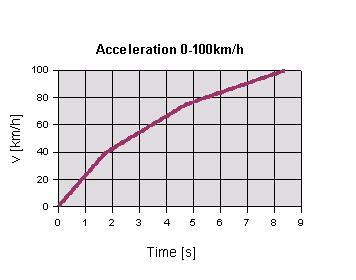
See the graph and be astonished:
Zero to 100km/h in 8.4s without giving more than rated current to the machine.
Thermal design
Ok I now know the machine can drive the car fast enough and will provide the torque I want. But can I really give some more than rated current to the machine later? Usually, EV-ers remove the liquid cooling system from their conversion but I think I would keep it. Here is the reason why:
It comes for free if I buy a Diesel-Loremo. The Loremo engine provides 36kW mechanical power. Diesel enginges, however, have an efficiency of only approx. 30% so about 70kW of thermal energy needs to be dissipated. Assuming that the car has to work with ambient temperatures of up to 50C while the coolant may not exceed 120°C you end up with a thermal resistance Rth of ?T/?P=70K/40kW=1.75K/kW. In this assumption a lot of heat is dissipated through the tailpipe but 40kW remain for the liquid cooling system.
1.75K/kW means, a heat source reaches 1.75K above the ambient temperature when 1kW of thermal power is dissipated.
Back to the maths :
The Brusa-motor has a rated efficiency of 94%. You won't get that all the time, but from their diagram I take it 80-85% can be fairly assumed. I'm conservative and will assume 80%. With this and 27kW of mechanical power, the losses in the motor are about 6.75kW but they are not the only losses. An inverter needed to drive the machine also has an efficiency less than 1. As the inverter needs to supply the motor with its mechanical power and losses it needs to provide 33.75kW of output power. Given an efficiency of 90% r - but knowing it will be far better than this - adds another 3.75kW of losses. You should have noticed that the calculation really is conservative!
With now 10,5kW of losses an the Rth calculated what happens?
Motor and inverter will reach a temperature level of about 21K above ambient temperature.
Semiconductors and heat
Semiconductors can be destroyed by a variety of influences - the most important ones being overvoltage and overcurrent. Both can be prevented by porperly choosing components and designing the system carefully. Two more effects exist. Cosmic radiation is the one I'm not going to focus upon too spooky...
What remains is again temperature.
High power semiconductors are stressed by two thermal mechanisms.
Power Cycling is when short bursts of power need to be handled periodically. This poses a threat to the internal connections, the bond wires. This effect is in a range of seconds or less. Thermal cycling, on the other hand occurs when semiconductors start operating at low temperatures and get hot during operation. This would happen if the power electronics have to drive a car in winter starting at e.g. -20C and then reaching their rated maximum temperature of 125C a few minutes later.
If the destination is reached and the car is turned off, the semiconductors again cool down to -20C.
One thermal cycle complete.
Thermal cycling stresses all components including case, silicon and especially the solder layers below the chips that degrade over time.
Both effects get worse if:
a) the temperature swing increases, so cycling from 20-80C is less stress than from 20-120C but also
b) if the temperature levels increase. Cycling 20-80C is less stress
than from 60-120C though the temperature swing is the same.
An increase by 25C upwards will halve the lifetime of any given semiconductor.
It can be concluded that lower temperature levels are always fine so that's the reason for me to keep the liquid cooling system.
Additionally, the Brusa will tolerate larger currents than the rated current as long as the winding temperature is not exceeding 150C.
You can see what happens? I'll get the few extra Nm without getting into thermal trouble.
So what?
The machine can drive and accelerate the car, there is no thermal problem, and the TV is not a problem.
But could I store enough energy to get the 300km/charge?
More long days of surfing, searching, calculating go by.....
So my E-Loremo dream is complete:
27kW electric machine instead of ICE, proper inverter as an "off the shelf" component, Li-Tecs or Kokams, depending on the price.
This leaves me with one choice that is not jet decided:
When my Golf-Battery is dead and needs replacement in a few years would I go for the Loremo and convert it or would I rather spend the money upgrading the Golf to Li-Ion?
I think this depends on how pregnant my wife is by then.(Ed: so E-Loremo fate is in your....hands?)
After all a Golf - yes, even an electric one - is a fine family car.(Ed: and so far you are a "fine family", right?)
Forum - to find all recent & archived electric Loremo threads: first register/log in, then Search Forum on keywords: E-Loremo EV
- We're in regular correspondence with US EV guru, engineer, and electric drag-race aficionado Roderick Wilde of Suckamps and EV Parts - and some of you may recall that in earlier EVUK articles, for reasons that may become clear later(read on!) - we have always taken the precaution of disguising Rod's true identity with the tailor-made alias "Lightning Rod" - see for example our Jan 2006 article "Cryptic News with Clues Breaks January Blues" for Rod's most recent little lightning bolt-from-the-blue...
Rod has spent many years in EV (drag-) racing in the States and has also been involved in US EV TV productions for the Discovery Channel (watch Gone Postal videos)
He's also uniquely qualified to be refreshingly blunt and direct with his comments and didn't disappoint when we asked him for his reaction to Lightning Car's ultra-bullish June press release - firing back the characteristically robust salvo below. And naturally we couldn't resist, in the end, sending a slightly toned-down version to Lightning Car's Arthur Wolstenholme for comment ...
...and so here, as promised, is Mr. Wilde's thunderous little 'Lightning Blitz' (surge protection recommended!):
Rod W: There is something really bothering me about this car with the specs that are claimed. There is no car on the planet with over 700 horsepower and over 2132 foot pounds of torque that can possibly be this slow. Lightning claim for instance that: "Each HPD40 drive unit offers maximum torque of 750 Nm (533 lb-ft)"
- and they run four of these motors. By comparison, the Saleen S7 has about the same horsepower and only has 700 foot pounds of torque and does 0 to 60 in 2.8 seconds and it is not light at a portly 1338 kg, almost 3000 pounds. The only car I can think of that is almost this slow is the Porsche Carrera GT which has about one fourth the torque and only a measly 612 HP and it can still turn a 0 to 60 in 3.6 seconds. It must take a lot of brilliant British engineers to come up with a way to squander so much torque and horsepower and not get it delivered to the road."
Rod rams home his final point:
"Show me the actual test results. I do not want to see press releases from a marketing department. If you can show me actual test track results I will apologize profusely. This is a very simple and logical request understood pretty much globally. This is not some off the wall request - just please show me some test results. The problem you will find is that there aren't any. No one has built and tested a functional prototype. If you want to believe press releases in your country then join the thousands of people in our country that do as well."
And here's Arthur Wolstenholme's sporting response:
Arthur W: In typical British fashion, we believe in erring on the side of caution rather than over promising at this early stage of the electric Lightning's development. The performance figures referred to are best estimates following close collaboration with our technology partners and demonstrate our intent for the car. Once the prototype has been completed, tested and validated we will be pleased to share actual performance figures." He continues: It is an important point to note that we are working to achieve a credible and usable combination of acceleration, top speed, range and safety in the production version of the electric Lightning - not just the quickest 0-60 time.
The other three points that we(EVUK) put to Arthur Wolstenholme were a little less..
incendiary..than Rod Wilde's: (Q&A cont'd)
EVUK: Our first question concerns AltairNano Li-ion batteries. Many reports (eg. see Edmunds Inside Line - usually a reliable source) have stated that you(quote) : "..have teamed up with U.S. company Altairnano to develop a new battery that it says uses "advanced novel ceramic nanomaterials" instead of toxic chemicals ..."
So do you in fact, as many reports have implied, not intend using the exact same Nanosafe cells that are being used for example by Phoenix Motorcars in its much publicised rapid-charge electric SUT's and SUV's? Have you indeed "teamed" up with Altairnano to (quote) "develop a new battery" ?
Arthur W: Please be careful about what you read in reports - we are not developing a new battery with Altairnano. We have selected their NanoSafe battery as our proposed power source. I cannot confirm the exact technology Phoenix are using, however they are also using Altairnano product.(Ed: yes - they are both using the same cells)
EVUK: We're always meticulously "careful", cautious and inEVitably sceptical about what we read in reports - which is of course precisely why we(and, from what we can tell, we alone ) - are now questioning those many identical reports that stated that you had "teamed up with U.S. company Altairnano to develop a new battery..." !
EVUK: Our next question concerns the Lightning Sport's sale price: just what do you say to all of those who are raising eyebrows at that $295,000 sale-price? Probably the most frequently-heard and understandable reaction boils down to something like this :
"I could buy three Tesla Roadsters with that kind of money !" How do you respond to that ?
Arthur W: Two of the technologies we are using on the Lightning are the next generation battery and motor technology. The initial cost of this technology is the main reason for the high vehicle price. The Lightning also employs F1 racing technology derived chassis and carbon fibre/kevlar bodywork and is a full size GT car. The wide price range of traditionally powered sportscars can be seen in a similar way, the exception in this case is the exciting technology, leading to exceptional performance, now being employed in the Lightning GT.
EVUK: Our final question relates to in-wheel motors. (See PML's July press release "Hi-Pa Drive Chosen to drive Lightning")
EV developers still seem divided over whether the technology is dependable even now - weight, balance - and ultimately safety concerns - still linger.
Mitsubishi, who are arguably further along the road than anyone else when it comes to real-world in-wheel-motor testing, have said that the MIEV i will not after all use wheel motors. And whilst the specifications and performance of PML's motors certainly look impressive, have you ever actually seen their technology being track-tested and proven under real-world conditions and verifiably delivering on its performance promise? Even if only on a rolling test-bed of some description? In other words, can you say what ultimately has persuaded you that
PML's motors can and will deliver on the company's stunning performance claims ?
Arthur W: We chose PML for the motors for our car because of their outstanding performance and advanced technology* that is well suited to our high performance sports car. These motors will likely exceed our expectations of performance and reliability.
*********
*Note: Arthur W's last response (highlighted) of course neatly sidesteps our - and Rod Wilde's - key $64k question re: real-world proof-of-performance, independent testing etc - so we put
the same questions to PML Flightlink(MINI QED) who will be supplying the wheel motors for the Lightning Sport.
So here is the email we sent to PML Director Martin Boughtwood(a summary of his telephoned response follows...) :
EVUK: We're currently talking to Arthur Wolstenholme about posting up a Q&A piece re : Lightning Cars. We have been following PML Flightlink developments for around four years(ie. since well before the MINI QED)
Our principle question is almost inevitable at this point and is being echoed at almost fever pitch throughout the EV community, EV blogosphere and in the mainstream automotive world : we're referring of course to the conspicuously moot point - the key, multi-million dollar question - as to whether the PML Mini QED and in particular the Hi-Pa drive system, have yet been independently tested, performance specs verified etc- on the track and out on the open road?
And on the same "proof/independent test" theme : does PML have any video clips at all of the Mini QED being track or road tested(to its limits)? Or simply in motion at any speed(we can find nothing..) ? The BBC (watch video) reporter Paul Clifton comments that the BBC have been "promised" a test-drive "later this summer" and Channel Four also used that word "promise" - "promises 640 bhp"- in its 2006 MINI QED report.
Given that ZAP too are basing their press releases and (almost)incredible top speed(155 mph) performance and range(350 miles) claims for the ZAP-X (Lotus APX) on the performance promised by PML electric drives we know we are now far from alone in thinking that it must surely be time to let the world - and especially sceptical journalists - see what the Mini QED, for example, really can do in the real world. There is so much at stake here - so many roads now seem to be leading back to PML Flightlink's electric drives and to yet-to-be proven(and video'd ?) performance claims.
Also: your business strategy or philosophy seem to be very different for example to that of AC Propulsion who developed the TZero battery and drivetrain solution from which the Tesla Roadster's powertrain is derived(though few seem to be aware of that fact!) : AC Propulsion spent around eight years very publicly testing and racing(and video'ing) the li-ion and lead-acid Tzero's as they took on and easily outpaced Porsches, Ferraris etc and frequently proving its 300 mile range & acceleration(0-60 in 3.7) to journalists and others again and again out on the open road in the US. Tesla have adopted a similar approach - eg. Schwarzenegger, Goodwood and video clips galore... So - is there any possibility that this might soon happen with respect to the Mini QED and the Hi-Pa drive? Not least in order to silence the sceptics who - believe me - would all love to be persuaded in the same way that we(and Tesla and Venturi etc) were convinced by real-world independently witnessed and video'd evidence of the Tzero's fantastic performance and range ?
We put all of the above points to PML Flightlink's MD Martin Boughtwood and in a lengthy telephoned response he told us that the company hopes to have something test-able out on the track by August(we are - or were- invited) - but
assures us that within the next 6-9 months we will definitely be able to visit PML and see a functioning prototype in action. So we will hopefully have good reason to visit Fareham very soon - video camera in hand of course...
Now we wonder if we could bring a certain "Mr. Wilde" along for the ride - incognito perhaps?!
Duran Duran in Tesla Roadster at Live Earth?
- Pure fantasy - or what??
If they can get a Tesla to Goodwood FOS - why not to Wembley and Live Earth? Click image for Goodwood Tesla clip
When we read a few weeks ago that the Tesla would be on show at the Goodwood Festival of Speed we instantly and naturally thought, "Hey - if Tesla and Lotus can get a driveable vehicle out to a UK Festival of Speed - then surely they could turn it out for the world's biggest ever, billion-plus-viewer live simulcast Festival of Saving Planet Earth - aka Live Earth !"
Well, after sitting on the idea for a few days we began pitching it to contacts and fellow EV campaigners around the globe - eliciting(most notably perhaps)- a particularly enthusiastic response from Richard Titus, UK producer of Who Killed the Electric Car? - as well as from Blair Golson a manager at Participant Productions, the company that produced Al Gore's film Inconvenient Truth and co-produced Clooney's Syriana & Good Night and Good Luck.
Gore himself of course is the driving force behind the Live Earth concerts and in fact has been visiting Wembley over this last week giving TV/media interviews and generally overseeing proceedings there...
And so here is some of that (EVUK's) Tesla-Duran-Live Earth sales pitch - delivered to all of the above just 4/5 days ago:
"We see that Tesla Roadster took part in the recent Goodwood FOS and wondered if you'd considered getting the car down to Live Earth at Wembley("the biggest charity event in history") - to share top billing and the stage with Duran Duran perhaps?
Picture the darkened Wembley stage - a sudden lightning & smoke flash-effect and the one line "It's Electrifying!" from the original Grease soundtrack exploding from the PA as spotlight picks out Tesla Le Bon et al in/on Tesla rolling into view. We've even written possible one liners Le Bon could ejaculate as they leap out of the Tesla:
"Don't worry Al (Gore) - it's Electric!"
(Yes -we know Mr Gore is well aware of, and a fan of the Tesla - but we're going for the laughter factor here!)
More one-liners for Simon Le Bon et all could be, for instance: "Do we get to keep the car Mr Gore..Mr President...Sir?!"
"The future has arrived and so have we!!"
"It's one of the fastest cars on the planet - and it's made in Britain and the US...just like us!"
"Hello Wembley etc...!"
Obviously it would be fine (and less of an insurance risk..?) if the car and "passengers" were simply pushed - unseen from the wings - on stage by a couple(a 'herd'..?) of hefty roadies to avoid any Richard Hammond-like fiasco.
Come on guys, it's British, it's patriotic, it's at the new Wembley, it's a Lotus, it's a US-UK "coalition" effort - so the BBC would surely give it the green light(sorry - can't stop pitching!). This is surely written in the stars - and for the stars ... (end of EVUK's original 'sales' pitch)
Anyway, to cut a long(-ish) story short: we(EVUK) eventually contacted John Lamb(Group Lotus PR, UK) and Tesla Motors' Marketing VP Director Darryl Siry in the States - and he seemed mightily impressed by our ripping go-for-it sales pitch and style: "That is possibly one of the most interesting pitches I have ever heard !"
"Yes! Yes! Cut to the chase!" we hear you all cry. "Did you pull it off? Is it going to happen? Duran Duran's Big Stage Entrance in/on the Tesla Roadster?"
Well, sadly... not ! After another 72 hours or so of hectic transatlantic emails and phone calls, Darryl Siry (Tesla) finally(June 4th), and after much deliberation, came back to us with the decision to pass on the idea - citing a number of reasons...reasons which we feel it would be inappropriate for us to disclose or discuss here(sorry!).
Suffice to say, perhaps, that there is very good reason to believe that if we'd begun 'selling' and pitching this 'Tesla/Duran at Live Earth' idea a week or two earlier, EV fantasy could have turned to EV reality at Wembley on 7/7/07...
And of course if Live Earth had been Schwarzenegger's baby rather than Al Gore's - well - we'll leave that to your imagination....
But a massive high-five must go out to Black Eyed Peas' founding member Will.i.am(sic) for delivering the following chatty, expletive-free gem at around 14.30 UK time on 7/7/07 - sadly not during their superb stage performance(click image to watch - and more importantly hear - "Help Us Out" - a Youtubemust-see...lyrics here), but beforehand, in the panoramic Wembley studio with Jonathan Ross:
Jonathan Ross : ...a lot of rap and hip-hop artists like driving around in huge cars like the Hummer.... do you think that artists like 50 cent for instance would ever think about getting small electric cars..?
Will.i.am : I'm getting ready to blow up my Hummer. I have an electric car - a Tesla(*see below)....
Ross : I don't know about blowing up the Hummer - whether that would be very environmentally sound..
Will.i.am : No - we'll crush it instead...
*Note: Tesla's Darryl Siry(see above)has confirmed that Will.I.Am has indeed put down a deposit on a Tesla. Boy - we'd love to get a photo or clip of that Hummer-crushing fest. Maybe you could cut it into your next music/MTV video, Will.i.am..?
And later in the programme Scottish-American actor
John Barrowman(don't mention Tom Cruise) told Graham Norton that he was: "in the market for an electric car".
We're assuming that he too is referring to the Tesla...why else would he imply that he's having to wait to get one?
And finally: regular EVUK'ers will know that the BBC's 'MC' Ross and 'MC' Norton(formerly of Ch4) have not always been as environmentally/politically charged-up and out-of-the-closet as they were on 7/7/07 - see:
(As reported recently and fulsomely - by Germany's highly-rated daily SCi-Tech-Eco TV magazine show "Nano" - click for Google translation of transcript. Nano is broadcast unencrypted Europe-wide via Astra 19 degrees at 17.30 UK time)
"We don't know where we are going, and we don't know how much time it will take. We only have one intention: Covering at least 50'000 km, 50 countries, 15 months and 5 continents. A world circumnavigation, from West to East. The tour starts and ends in Lucerne, Switzerland.
"When the whole world is talking about global warming, it's time to bring the solutions!" says tour director Louis Palmer. "Where are the inventors, the organizations, the individuals and scientists who care about global warming? We would like to share our ideas with you! Our exact route depends on the invitations that we get!"
Louis Palmer and his dream green team of enlightened adventurers, engineers, academics want us all to get involved in this ambitious project and call him out - taxi-style - to visit and publicise green projects en route or not-so 'en route': a week or so ago EVUK made first contact with Louis - our first two questions, perhaps predictably, were "Will German, Swiss, international media be cutting live to you on Live Earth Day on 07/07/07 at all....and will you be going anywhere near Lake Como and Mr.Clooney's residence...?"
Well, the answer to the first question was, "No, so far no Live Earth link-up has been arranged.." and to the second, "Lake Como - as it happens we do have a base not many miles from Lake Como...it would be fantastic if Clooney could be persuaded to invite us in for a quick test-drive and chat..."
So we obviously had to immediately put a polite shout out to our smattering of contacts in California and on the greener side of Tinsel Town...but - what the hey - since this is all very last-minute and improvised - here's a direct and shameless little megaphone/carpe diem shout-out:
"George, Signor Clooney - if you or your people could possibly spare 15 minutes of your time and you do happen to be in residence in Italy over the next few weeks - would you please consider giving Louis a call? All he and we would hope for is just one simple photo of yourself at the wheel of the Solartaxi - that's right - just one discreet understated photo of one the world's most widely respected stereotype-shattering philanthropists, (eco-)campaigners and EV early adopters(Tango and Tesla) could take this ambitious project to a whole new audience - and most importantly persuade our ever-reluctant old media to get on board too..."
Louis Palmer has sent us this exclusive video file - click image to see stunning scenery...and Solartaxi holding its own against typical traffic around beautiful Lake Lucerne...
"All our fossil resources are being used and dumped into the atmosphere...we could do it differently: let's use the technology we already have! New jobs, a new quality of life and new perpectives for the future could be found. These solutions are readily available, but they are simply being ignored. The Solartaxi will be visiting pioneers who have the solutions - and present these solutions to the world."
- If you'd told me a few weeks ago we that I'd be posting up a report about an EV event attended by the Japanese Minister of the Environment with exclusive video footage of the Mitsubishi MiEV i, the Subaru R1e, the Eliica, the Ecoron(who, what...?) - I wouldn't have believed you.
With no knowledge of Japanese it really is a struggle, even with cyber-translation aids, to get any information about EV events here. I'd been trying for three weeks just to get a response from the Japan EV club - with no success.
But my luck changed following an email I'd fired off late one night to Paul Scott(left), co-founder of Plug-in America , a long-time EV campaigner, RAV4 EV driver and "Who Killed the Electric Car?" contributor.
"Why not try contacting Eiichi Oogami - he owns a Toyota RAV4 EV" said Paul. "He's a terrific guy."
Paul Scott couldn't have described him better: Eiichi's emails sparkled with enthusiasm and were long, detailed and, yes, in perfect English. Hallelujah!
Suddenly I didn't feel quite so hopelessly 'lost in translation'. So when an email from Eiichi titled "Eco Car World this weekend in Yokohama !" landed in my Inbox I was near-ecstatic(no -really!). And just one greased lightning Google blast later I'd found among other things that the Minister of the Environment was going to be delivering a speech at the event at 12pm in Yokohama and discovered later he was also given a test drive in the li-ion Eliica.
Blowing a kiss to Eiichi and Paul Scott and unable to believe my luck - I grabbed my guide-book, map and most importantly my new video camera and headed for Aka Renga Soko, Yokohama. Two hours later(Tokyo is big!) I arrived at my destination stopping only to watch a Japanese gospel choir sing "It's gonna be a lovely day!" Yep - my words exactly.
Click image for Japanese Gospel Choir - filmed by devout EVUK EVangelist Moira G..!
I spent a good two hours or so walking around filming the EV's on display, soaking up the clean atmosphere and the electrifying tranquillity. It had been such a long time since I'd actually seen any real EV's close up so it was like getting re-aquainted with old friends.
So enjoy all twenty five(at last count!) video clips, excuse my hyper-excitable commentary(I'm a dedicated unpaid unprofessional !), forgive my faltering attempts to make myself understood in English to these incredibly talented engineers - and wince at my occasional shrieks of joy for having at last found the elusive (test-)Ride and Drive Area.
Eco Car World - the complete & exclusive video clip collection :
Hello from Eco Car World - EVUK's Moira G. between Subaru R1e and MiEV :
Zero EV Elecseed RS :
Moira squeezes into Elecspeed - and EVent / Yokohama skyline filmed from pier(with stench of boat diesel everywhere!) :
MiEV in action at the Ride and Drive, Eco Car World, Yokohama :
Subaru R1e :
Subaru R1e in Action Extra! :
Subaru R1e with more Moira G. commentary re range, availability etc:
Extended video clip of MiEV and me shrieking with unprofessional glee ! :
Come ride with me - in the MiEV :
Short clip of MiEV at Ride and Drive :
MiEV (photo only):
You can buy this 4-door 120 km/charge li-ion Ecoron EV now in Japan! :
Eliica - on display only(video) :
Professor Shimizu's(see Eliica) pocket-sized 130 km charge li-ion 2-seater Luciole EV - on display only :
....and again :
Full MiEV specifications - in Japanese ! :
"MiEV in Europe - when ?" - I ask Yasufumi Sekine - Assistant Manager, Environment and Recycling Affairs Department:
When will MiEV be for sale anywhere? I ask Mitsubishi engineer Yoshiaki Sano :
Poppping question about in-wheel motors for now not-so-innovative MiEV :
...and again !:
Hybrid Ecology Truck - a beautiful lorry with a lorra in solar panels! :
Honda FCX in action :
Eco Car World - a musical, open-fresh-air panorama :
*****
Now for some sobering post-event perspective - a reality check or two :
- In 1999 - eight long years ago- Mitsubishi achieved a record-breaking 2,148 km in a lithium-powered FTO saloon(pictured) -
world record noted by Guinness Book of Records. See photo-report(there scroll to last page):"New EV Distance World Record".
And six years ago in 2001 a Mitsubishi Eclipse EV was driven more than 400 km on a single charge at Japan's Shikoku EV Rally 2001 - see detailed photo-report. Both of these record-breaking achievements went almost completely unreported in the English-speaking media('old' and 'new') and was covered almost exclusively outside of Japan by..us, EVUK...talk about "conveniently lost in translation" !
So by 2010 it will have taken around 12-13 years to produce and sell the MIEV i - an EV with a range of 130 km. And by 2015 when a 200 km/charge version of the MiEV is slated to go on sale it will have taken 17-18 years. So why has it taken so long? Why the roadblock? It surely cannot be due to technological challenges alone - especially now that in-wheel motors have been temporarily at least taken out of the equation by Mitsubishi....
At Eco Car World a part of me felt like I was in an art gallery - or a museum when even now, in the unimaginable sci-fi year of 2007, we have nothing in showrooms for people to actually buy and drive. And then there's the range. Yes the Subarau R1e benefits from a quick 15 minute recharge and the MiEV i will have 20 minute quick recharge capability at a network of eco stations to be set up at supermarkets etc. Yes - the Toyota RAV4 was launched in 1997 and had/has a range of at least 160 km - yet here I was looking at the MiEV with a range of 130 km and the Subaru R1e with an even lower 80 km! And after trying to find anyone who could speak English it soon became clear these EV's were not going to be even for sale any time soon. Tokyo Electric Power Company want the Subaru R1e now but the car company will not let them get their handa on it until 2009. Other companies will have to wait until 2010 for the privilege. When it will go on sale in Japan is uncertain - maybe 2013 but with a range of possibly 160 km..
- Moira is a RADA-trained, classy working class actress with a degree in Languages who has worked in various TV productions over the years incl. Inspector Morse and Heartbeat. She has also performed in several West End fringe theatre productions - principally at the Tricycle Theatre.
She fills in the acting gaps('Resting"? No way!) by teaching English(TEFL) around the globe and through her spirited and scandalously unpaid(did we mention that already?) contributions to the EVUK website and EV campaign activities. Oh - she's also a great party-time piano-player(rock,pop,gospel,classical - you name it). Age: let's just say that in December 2006 Moira was asked for ID when purchasing wine at her local supermarket ie. she looks and acts a whole lot younger than her Morse appearances would suggest...
So - if anyone should feel they could use(and pay for!) M.G.'s eclectic talents and energies in any serious EV/eco-tech/green media-related enterprise - please contact us !
1000+ miles/charge Lithium? Scottish scientist's high hopes for ' O2 Electrodes'
"We propose a step change in rechargable lithium batteries...
The capacity to store energy can be raised by 5-10 times...The proposal addresses a number of the materials issues necessary to realise this radically new high energy storage battery ....".(Professor Peter Bruce - click image for full text)
Admittedly, this is not exactly late-breaking news but if Aberdeen-born Professor Bruce and his team at St. Andrews University(*see footnote) do indeed succeed in achieving even the lower end of their energy storage goals(ie. "5-10 times" current Li-ion capacity of 130 mAh/g ) it could eventually lead to the complete transformation not just of the worldwide automotive sector but of the energy storage(ergo supply & security) landscape as well.
So it does seems a little surprising that this $3 million EPSRC-funded "step-change" research project has yet to raise even the tiniest of blips - as far as we can tell - on the global EV news radar.
It is also worth pointing out that, although this formally funded research is at a very early stage, the idea of using O2 electrodes in lithium batteries is not entirely new - Peter Bruce has himself been informally discussing and investigating the concept for some time. Read the second half of this Nov 2006 MIT Technology Review piece "Making Electric Vehicles Practical" for an insight into the challenges that Professor Bruce and his colleagues will have to tackle.
Earlier this week we asked Peter Bruce if he would care to comment on the issues raised in that MIT Tech Review piece - here's his response :
"Using present approaches, the energy density of rechargeable lithium batteries may only double. It is vital to look for new approaches and directions, and that is what the air electrode offers. This is still at the basic science stage and as a result it is not possible to give definitive one line answers".
He continues: "According to MIT the theoretical capacity is from 1200 to 1800 mAh/g and we have shown practical capacities of 900 mAh/g so far. More work may or may not improve on this - that is the problem with statements at this stage. Practical for LiCoO2 is 130 mAh/g. So a factor of 7 times has been demonstrated. Stan Whittingham's comment and mine are the same. In my words: The difference between Open Circuit Voltage(OCV) and load is 300-400mV. Reducing the voltage difference will be an important target for future work".
scientists have succeeded in almost doubling Li-ion storage capacity, let's not forget that the best may be yet to come - and it could come from Scotland...
Indeed, you may recall EVUK's own deliberately(..and successfully?) provocative May '05 headline announcing that same earlier Scottish intitiative - "Scots Beat English...with New EV Initiative"
...and speaking of Scottish parliaments and Peter Bruce's 'radical' thinking... Radical ancestry ? King Robert the Bruce (watch 2007 movie trailer) helped achieve the 'impossible' - Scottish Independence in 1328. 700 years on,liberation from fossil fuel dependency is one 'impossible' goal of radical thinkers(and do-ers) north of the border.
Bruce(Robert !) also held his first parliament in ... St. Andrews(!)
Click here for full details of Peter Bruce' s stellar career in Materials Chemistry. (*Footnote re: St. Andrews - Scotland's oldest university(map). Our apologies to all rightly rabid Scots for the unspeakable error in our first draft !)
Possibly the best, most up-close-and-personal report so far
- although understandably, for reasons of discretion, no specific reference is made to the collaboration with Lotus. And of course(far less understandably)AC Propulsion and that all-important Tzero legacy are again conspicuously missing from the conversation...
Zap CEO Steve Schneider interviewed on CNBC Powerlunch - click image to watch
May 2 '07Zap announces second UK link-up - this time with leading UK in-wheel motor specialists PML Flightlink. (Recap: PML's Mini QED(inset) - a superfast, ultra-efficient and compact plug-in-able hybrid. See EVUK report Sept 2006)
July 21 '98(!) EVUK's Moira G. heads to California to spend 3 months working for Zap , touring the other sunshine state' s EV hotspots and tracking down Hollywood stars and their electric cars.
O Happy, Zappy Days!
- Back then of course we all believed that a US-led EV revolution was just around the corner - and with good reason...many good reasons: the Toyota RAV4 EV, Honda EV Plus, Nissan Altra, GM EV1 were all on the road and leading the charge, the Mercedes "A" Class EV was set for production in '99, California's ZEV mandate was in full force and the internet - we felt sure - would get the truth out at last to a largely comatose, misinformed public. To top it all, the stereotype-demolishing 4-seater(unlike the GM EV1) Solectria Sunrise sedan(see below) had achieved 373 miles on a single charge in 1996 - just four years after the Rio Earth Summit - and was slated to be mass-produced and sold for around $20,000 before the decade was out.
As it turned out of course, even we underestimated the power of our corporate, political and (therefore) media establishment (aka 'corporatocracy')to pull the plug on all of the above as well as their collective ability to lull the public(and themselves) back into that all-too familiar state of (EV/ZEV) amnesia, apathy and ignorance.
Joining the dots & connecting the news wires : . In-wheel motors are out: Mitsubishi announced in October last year - disappointingly - that the MIEV "i" car will not after all employ in-wheel motors and that the "i" in MIEV now signifies "innovative" - not "in-wheel"(so "MLIEV" - "less innovative" - would seem more appropriate).
On a happier note, Mitsubishi also announced its plans this week(press release, May 8) to begin production of high capacity large lithium cells by 2009 in a joint venture with GS Yuasa : "These new batteries have ten times the capacity of those for hybrid electric vehicles, and are the perfect choice for EV's. ". . Solectria Sunrise(1996) - probably the best electric car never made. It goes without saying of course that the world's media - esp. in Britain and mainland Europe - simply refused to show any interest whatsoever in the Sunrise - despite our own relentless email-blitzing efforts to get the car on the radar here. As a result, around 99.99% (an informed estimate) of the world's population ever-so conveniently have no knowledge or memory at all of this 4-seater, 200 miles/charge, 75 mphmyth-busting EV.
Stephen Taylor's 200 miles/charge lighter lithium Sunrise - click image for Austin EV photos & detail
Read these two illuminating and pithy CREST postings from April 2000 and Sept 2002 - if you're not yet part of that informed and eternally vigilant "0.01%" ...
Naturally many of us did, over the years, repeatedly contact the Solectria Corporation to try to establish why the sun set so sudddenly on the Sunrise - but the company's replies were always politely evasive and firmly focused on future plans in other areas - leading some inevitably to suspect that the company, at some point, had probably been made offers(by GM..?) it couldn't refuse. Watch rare video clip(Youtube) of Solectria Sunrise in action(..it's the yellow EV featured near the start) . ...from Lotus-Zap and long-range, sedan-sized EV's to Lotus-Tesla and long-range, sedan-sized Ev's. Tesla have said recently(see for instance CNET & Inside Bay Area reports) that although their own 200 mile-per-charge sportssedan will cost between $50-70,000, a $30,000 family sedan may follow. Which leads us to offer one final thought:
Tesla ! If you should ever find yourselves needing a name for that affordable($30,000) long-range family-sized sedan, we'd like to suggest the ...
Tesla RICO !
- an aspirational anagram of 'Solectria' and a fitting salute / (fast-)moving tribute to the Sunrise sedan - an extraordinary EV that promised(..or threatened) to revolutionize the auto industry a decade ago.
Redford's "The Green" eco TV series debuts on Sundance TV.
Watch highlights, download episodes, watch and respond to video blog 'webisodes'...
But will real EV's be a red hot topic - or totally taboo here too ? (Email: thegreen@sundancechannel.com)
Well, given that Chris Paine's "Who Killed the Electric Car?" was given its world premiere at Redford' s Sundance Film Festival in early 2006, it would seem infinitely more likely that electric and plug-in hybrid vehicles will feature in The Green at some point than, for example, in BBC TV's "It's Not Easy Being Green" - a programme in which, all-too predictably, the concept of energy efficiency and conservation is applied religiously to the home - but not to the woefully inefficient and wantonly over-used petrol or (bio-)diesel-powered cars parked in all those scrupulously but incongruously green, pleasant and organic gardens.
"Each episode revolves around a different green theme as it spotlights a specific innovator or innovation that has the potential to transform our everyday lives. The series also features a cast of recurring expert commentators including activists, scientists, writers and environmental personalities who provide the big picture context for each week's stories."
All in all, The Green looks to be precisely the kind of show we had in mind when we wrote the following in our wildly popular sTop Gear" feature in 2004:
- Robert Redford in "Three Days of the Condor" "Oil fields! This whole damn thing was about oil !" (See
EVUK feature, March 2006)
Against that backdrop, there is every reason, surely, to expect that electric cars and - even greener - electric bikes and scooters will feature in at least one of The Green's 13-episode opening season.
That said, there will inevitably be concerns that the show's Lexus sponsorship and uncritical plugging of plug-less luxury hybrids could again stifle or kill electric car/electric vehicle content. Email: thegreen@sundancechannel.com
See also:
Eco TV / Verdi TV channel (Italy). Watch live streaming now or view on Hotbird satellite at: 11013 MHZ, 27,500 Ksps, Horizontal or Sky(Italy) channel 906....and ask yourself why British TV is still barren brownTumbleweed TV...
Note: for all their merits and despite the wishful-thinking".tv" suffix, Urth.tv and Green.tv - unlike The Green and
Eco TV - are not(yet!) genuine TV channels or broadcasters...)





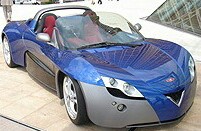



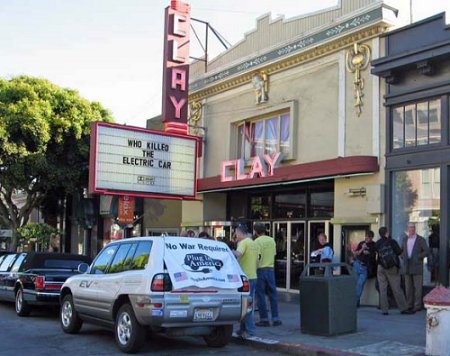

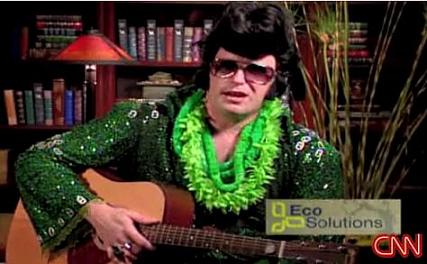
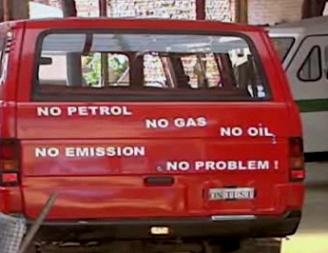
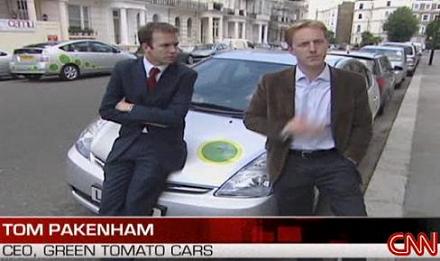
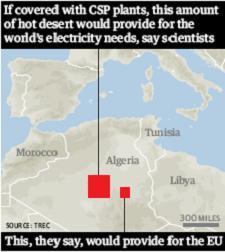
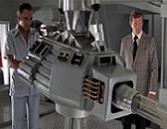
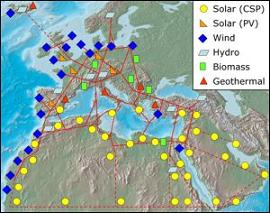
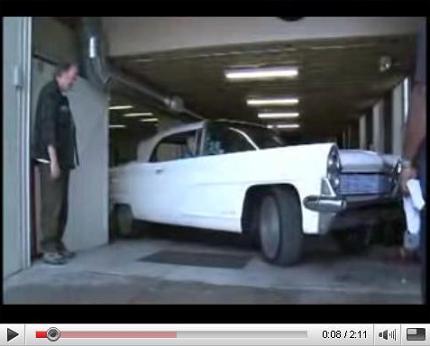
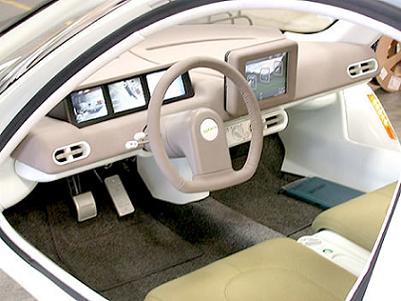
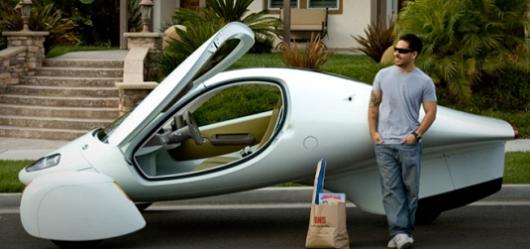
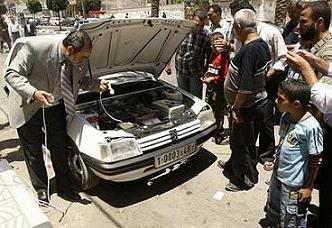
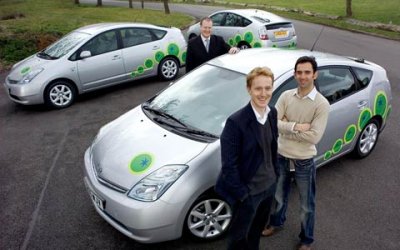
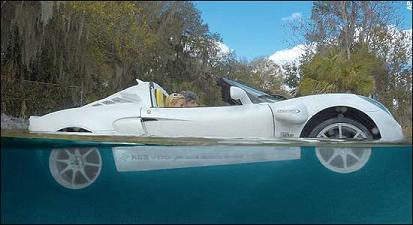
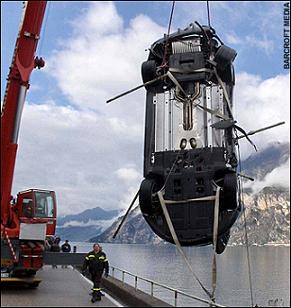
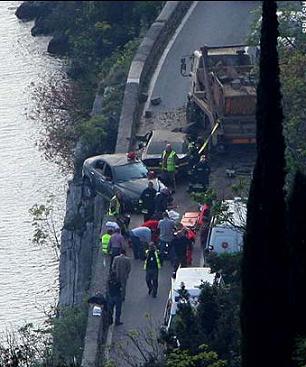



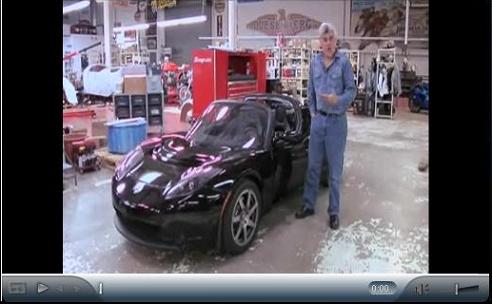
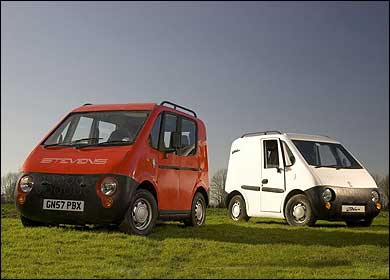




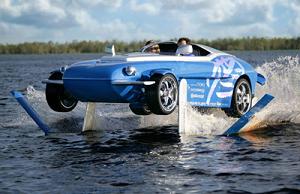
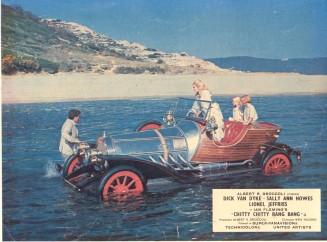
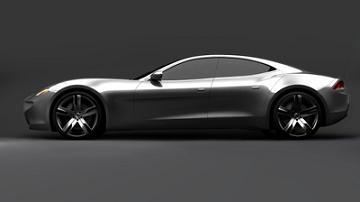

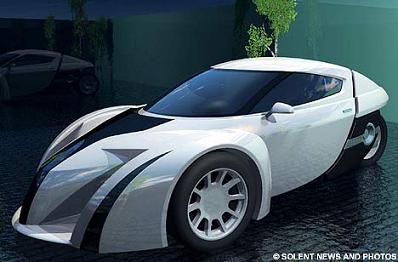

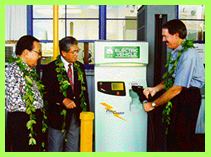
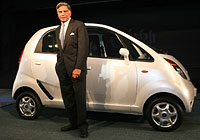
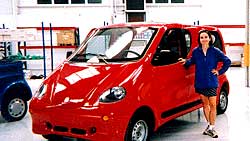
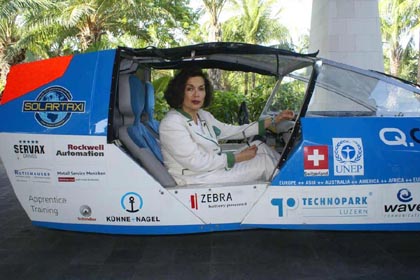
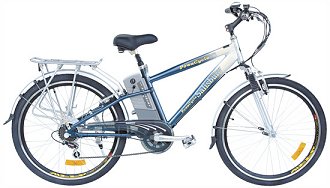
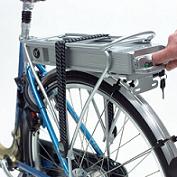
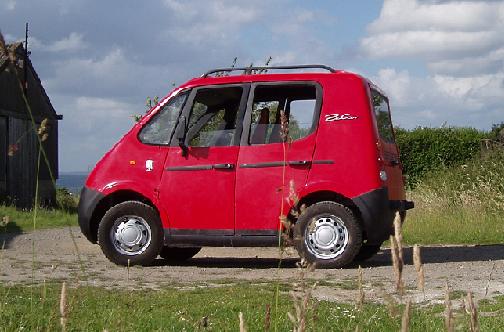
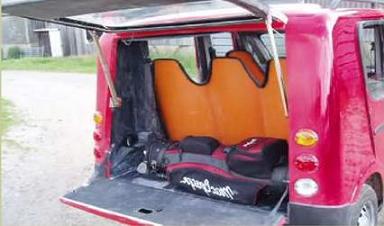
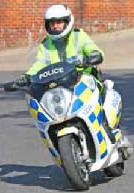
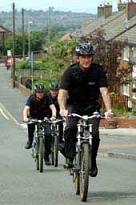







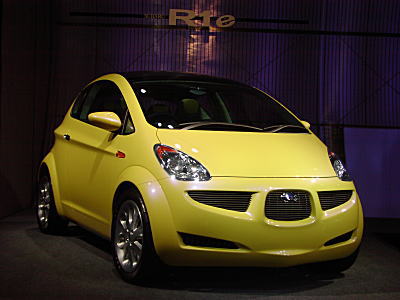
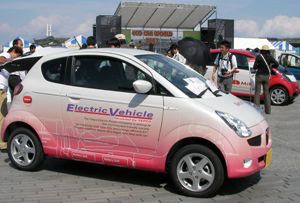
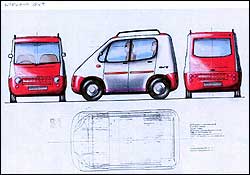

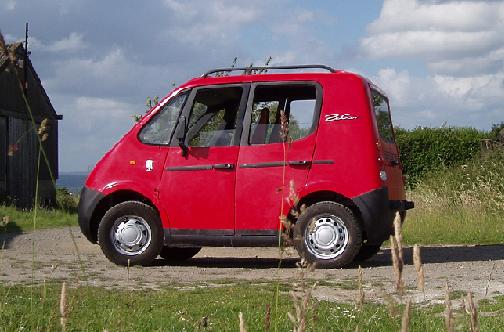
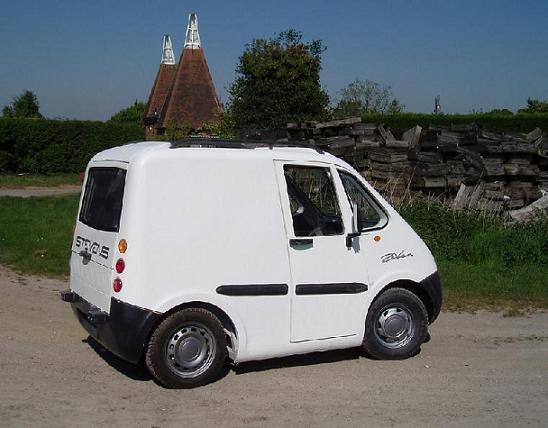

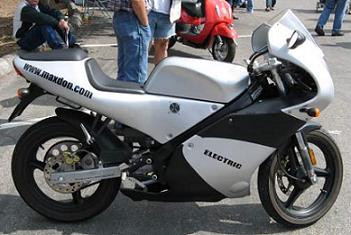
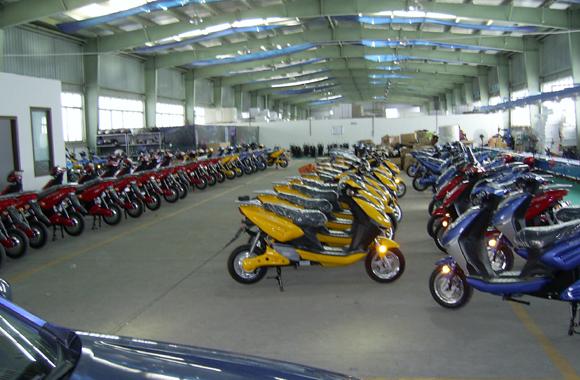

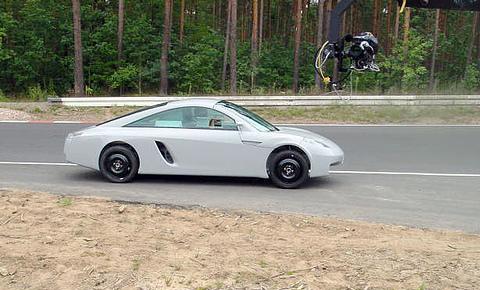
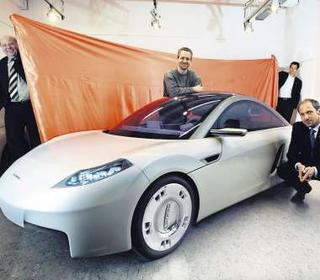
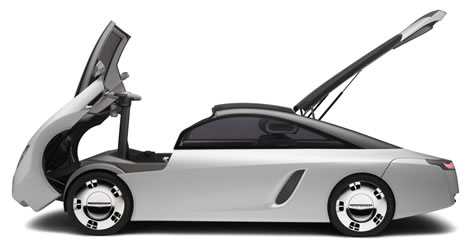
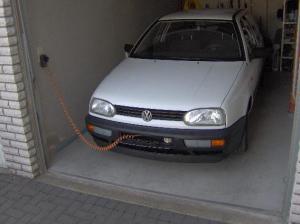
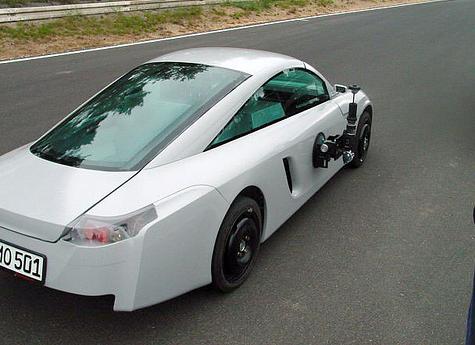
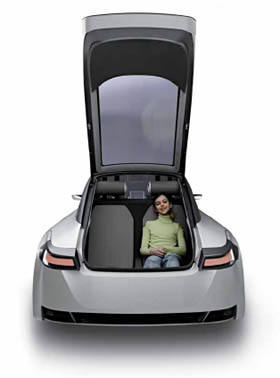 The first, most innovative idea of course: in-wheel motors!